
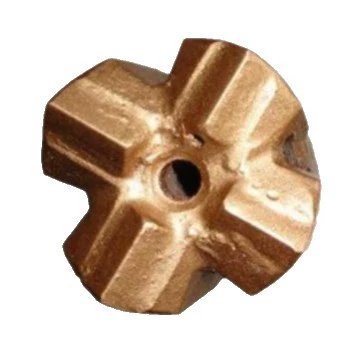
Use carbide button or cross-style rock bits for construction holes in 4,000–15,000 psi sandstone, limestone, or dolomite. Button drilling runs at 1,000–3,000 lbf/in of diameter and 25–60 RPM, with 0.7–2.4 MPa for DTH. A drag bit can work only at the softer end, using low WOB and 100–250 RPM.
Construction drilling often demands repeatable diameter and alignment across many holes rather than one isolated deep run. Medium formation covers sandstone, limestone, and dolomite between 4,000 and 15,000 psi, but those rocks do not all fracture the same way. Bedding, cementation, and quartz content can change wear and torque. The bit plan should preserve geometry while giving the crew a clear response when the ground moves toward soft or hard behavior.
Which cutting structure suits the planned hole?
A carbide button bit is the durable primary option when the rock is competent enough to need point loading. Top-hammer threads such as R32, R38, T38, T45, T51, and GT60 must match the drill string. A cross-style carbide bit can provide simple impact edges for smaller pneumatic work. Both depend on percussion and rotation rather than broad scraping.
A drag bit is possible only at the softer end of the medium class and is a poor fit when the rock becomes hard or strongly abrasive. It can scrape weak sandstone or similar material with low WOB, but fixed blades may chip in tougher cemented zones. Use the construction drilling archive for application options and the medium formation archive for the fixed strength and lithology definition.
How do button and drag parameters differ?
Button/DTH WOB is 1,000–3,000 lbf/in of diameter, and rotation is 25–60 RPM. DTH air pressure is 0.7–2.4 MPa. The thrust holds the bit against the bottom while impact creates fractures. Rotation indexes the carbide. Increasing RPM without a penetration response can raise sliding wear on the gauge row.
Drag drilling uses low WOB and 100–250 RPM. The data intentionally provides no numerical drag WOB, so the driller must use torque and penetration response. If the blade begins to bounce or torque rises sharply, the formation may be too competent for the selected structure. A change to a button or cross bit is safer than forcing the fixed edge.
| Construction condition | Bit approach | Operating facts | Restriction |
|---|---|---|---|
| Competent medium sandstone, limestone, or dolomite | Button or cross-style impact bit | 1,000–3,000 lbf/in; 25–60 RPM | Requires matching percussion system |
| DTH construction hole | DTH button bit | 0.7–2.4 MPa air pressure | No airflow-volume value supplied |
| Softer edge of medium class | Drag bit | Low WOB; 100–250 RPM | Not suitable for hard rock |
Hole diameter should be checked against the task before choosing among tapered, threaded, cross, and button designs. A nominal thread such as R32 or T38 identifies the rod interface, not the finished bore diameter. Mixing those concepts can produce a bit that connects correctly but does not meet the required hole. Confirm both values on the tool and job plan.
Construction work also rewards short, repeatable trials. If two adjacent holes cross comparable rock, use one controlled parameter change and compare penetration, vibration, gauge, and dull condition. Do not treat a faster hole as automatically better if the recovered bit shows severe outer wear. Repeatability across the pattern is more useful than one unusually aggressive run.
When the hole enters weaker material, reduce feed deliberately. The softer section may accept a deeper bite at the same setting, which can increase torque or pull the assembly away from alignment. Returning to the medium bed with that aggressive setting can then chip inserts. A transition note in the driller’s log helps the next operator anticipate the same response.
What does quartz change?
Quartz content above 20% makes any interval abrasive under the task definition. A medium-strength sandstone can therefore wear a gauge faster than a limestone at similar UCS. Inspect outer buttons and cross edges for flats, chipping, and loss of diameter. On a drag bit, watch the leading edge and body protection. A sudden change in wear may mark a mineral band rather than an operating mistake.
The U.S. Geological Survey can provide regional rock descriptions. A ScienceDirect rock-mechanics topic can support terminology. Neither source determines the bit from a formation name alone; the crew still needs returns, penetration, and recovered-tool evidence.
Where do construction holes lose quality?
Hole quality declines when a worn gauge row keeps drilling after diameter has fallen, when a mismatched thread introduces movement, or when cuttings remain under the face. Reaming with a damaged bit can enlarge one part of the hole while leaving another tight. Measure the recovered tool and relate any asymmetry to alignment and feed.
Drag bits may wander or catch in tougher inclusions. Button bits may produce uneven tracks if rotation is too low or the assembly is misaligned. DTH performance can fall when pressure delivery is inadequate. Each mechanism has a different correction; increasing every control at once hides the evidence.
How should the crew choose the next bit?
Log rock type, hole diameter, connection, WOB, RPM, DTH pressure where used, penetration, and dull condition. Separate sandstone, limestone, and dolomite intervals rather than calling all of them medium. If quartz-rich sandstone caused gauge wear, modify gauge protection or inspection timing. If hard inclusions chipped a drag edge, change the cutting system.
A button bit is the dependable default for competent medium construction rock. A drag bit is limited to the softer part of the range and should not be presented as a universal low-cost alternative. The best selection preserves hole geometry and gives the operator stable, interpretable feedback within the stated parameters.