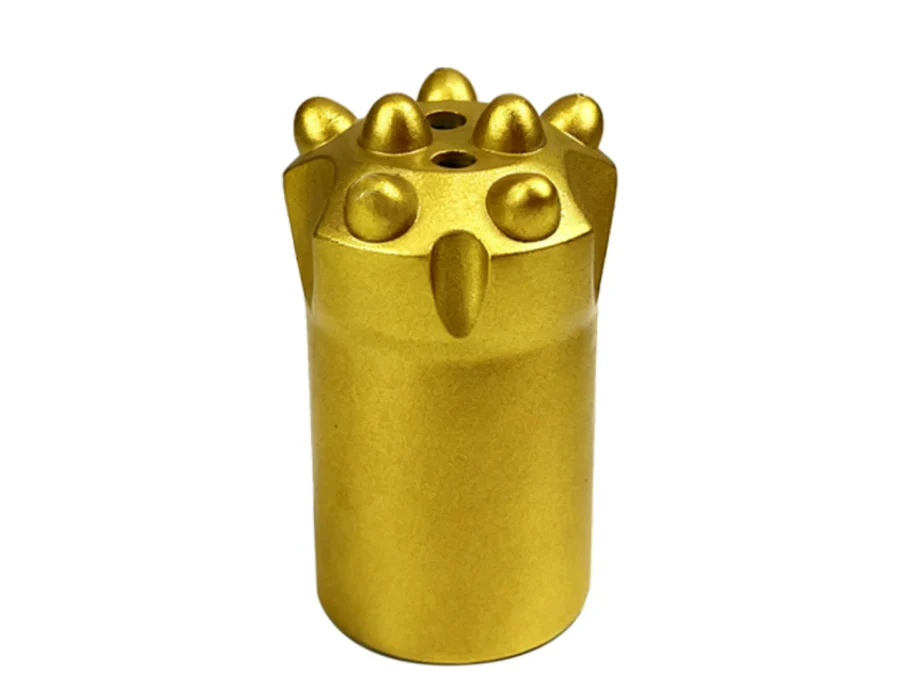
A 32mm button bit is a practical mining exploration choice when the core path or probe hole enters hard, abrasive rock. Match button geometry and thread to the rig, operate within 1,000–3,000 lbf/in of diameter and 25–60 RPM, and reserve drag action for soft ground rather than forcing it into quartz-rich intervals.
How does exploration purpose change the bit choice?
Exploration drilling must produce useful geological information as well as advance the hole. A fast tool that smears a contact, wanders at a boundary, or suffers uncontrolled wear can reduce the value of the record. Begin with the expected lithology and the observation goal. Hard formation spans 15,000–30,000 psi UCS and includes granite, basalt, and quartzite. Abrasive formation is any interval with more than 20% quartz, regardless of its strength class.
Button bits fit Medium, Hard, and Abrasive conditions. They are the main option for competent mining ground because impact breaks the rock while the buttons maintain distributed contact. A drag bit belongs only in Soft–Medium material and is specifically compatible with Soft or Unconsolidated formation. That limitation matters: a drag profile should not be presented as a hard-rock exploration solution merely because the hole diameter is small.
Use the hard formation drill-bit criteria when granite, basalt, or quartzite is expected. If quartz content exceeds 20%, also review the abrasive formation wear factors. Strength and abrasiveness describe different risks. A rock can fall inside a Medium UCS range yet still impose severe wear through quartz content.
What operating window supports a button bit?
Button and DTH drilling uses 1,000–3,000 lbf/in of diameter WOB, 25–60 RPM, and 0.7–2.4 MPa air pressure. Impact remains the dominant breaking mechanism. Rotation indexes the buttons to fresh rock and clears the face; it is not intended to imitate the 100–250 RPM scraping action of a drag bit. Apply load progressively and observe penetration, vibration, and return quality.
Thread selection must agree with the drill string. R32, R38, T38, T45, T51, and GT60 are top-hammer tool threads. A correct label prevents a dimensional mismatch but does not establish formation suitability by itself. A T45 button bit still needs a Medium, Hard, or Abrasive assignment. Conversely, a formation match cannot compensate for an incompatible connection.
| Exploration evidence | Engineering classification | Suitable response | Operating boundary |
|---|---|---|---|
| Granite, basalt, or quartzite | Hard; 15,000–30,000 psi | Button/DTH | 25–60 RPM |
| Quartz content above 20% | Abrasive | Button/DTH | 1,000–3,000 lbf/in of dia |
| Sandstone, limestone, or dolomite | Medium; 4,000–15,000 psi | Button or limited Drag | Button air: 0.7–2.4 MPa |
Why must abrasiveness be tracked separately from UCS?
UCS describes resistance to compression, while the quartz threshold identifies an abrasive mechanism. Treating the two as one scale hides useful information. A Medium sandstone may contain enough quartz to cross the abrasive boundary. In that case, wear protection and gauge retention deserve attention even though the UCS is below the Hard range. Record both descriptors in the bit plan and in the interval log.
Gauge loss changes hole size and can affect the interpretation of downstream measurements. Face wear reduces effective impact transfer. Broken inserts may point to shock or unstable contact rather than ordinary abrasion. Inspect where wear occurs instead of reducing the dull condition to a single severity label. The medium rock classification page helps distinguish strength class from the separate quartz criterion.
The approved data does not give a service-life promise for any button shape. Rock fabric, flushing, impact energy, and handling affect wear, so no fixed footage or hour claim belongs in the selection note. State the expected mechanism, monitor the returned material, and schedule inspection around observed response.
Which failure modes deserve an immediate parameter check?
Rapid peripheral wear suggests abrasive contact or poor gauge support. Insert chipping can follow excessive shock, unstable bit seating, or operation across broken ground. Slow advance with intact buttons may indicate insufficient energy transfer or poor face cleaning. Excessive fines and recutting point toward removal trouble. Each symptom should be tied to depth and lithology before a corrective change is chosen.
Remain inside the stated range while diagnosing. Button load stays at 1,000–3,000 lbf/in of diameter, speed at 25–60 RPM, and air pressure at 0.7–2.4 MPa. A setting at the upper boundary is not automatically better. If the hole passes into unconsolidated gravel, the limitation is formation compatibility, not a lack of additional WOB.
Regional geology can be checked through U.S. Geological Survey resources. Rock-mechanics topic summaries are available from ScienceDirect Topics. Use those references to support geological interpretation, while keeping all operating figures within the stated ranges.
How should the exploration crew document each run?
Record the bit family, diameter or thread, expected formation, starting settings, and observed returns. Note the depth of every material change. If the interval moves from Medium sandstone into Hard quartzite, preserve that transition in the log rather than reporting one average formation. Pair photographs or dull observations with the same depth references.
A concise run review should answer four questions: Did the bit match the logged class? Did the settings remain inside the allowed window? Was air removal adequate? Did wear appear on the face, gauge, or individual inserts? This evidence supports the next selection without inventing performance claims. It also exposes when a drag tool has reached its Soft–Medium limit and a button system is required. Measure gauge before the next run.