
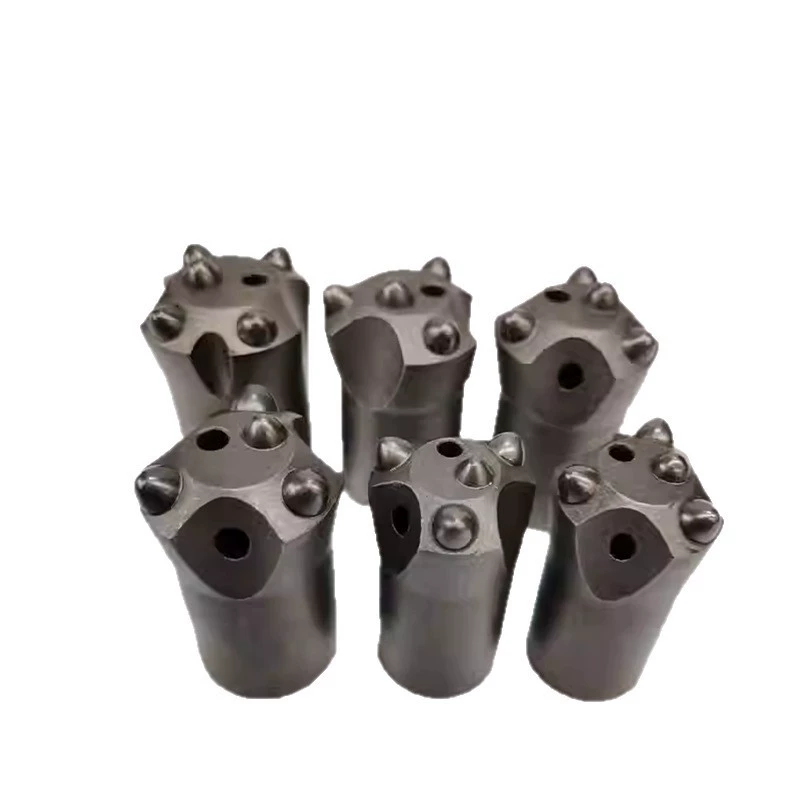
Product Description
This 90 mm DTH button bit is intended for competent mine rock, quarry holes, and water-well sections where down-the-hole impact provides the primary breaking action. The 3.54-inch gauge belongs to a compact DTH class, but hammer fit must be confirmed independently. Compare the job with the water well drilling application archive and the expected rock with the hard formation archive. It should not be treated as a loose-gravel stabilizer or a substitute for casing advancement.
The source identifies wear-resistant carbide ball teeth on a 90 mm DTH body. The engineering record therefore uses an alloy-steel hammer bit with fixed carbide buttons, without inventing a face profile or button count. DTH shank geometry is critical, yet the filename does not name a hammer series, spline pattern, foot-valve arrangement, or port count. A nominal 90 mm diameter can be produced for several incompatible shanks. Confirm the hammer make-up dimensions, gauge layout, and flushing passages before matching this bit to field equipment.
Use 1,000–3,000 lbf/in of diameter, 25–60 RPM, and only the air pressure permitted by the verified hammer program; the approved button/DTH reference spans 0.7–2.4 MPa. Start below maximum settings until returns and impact response are stable. Hard and abrasive rock are suitable, while broken or unconsolidated intervals can reduce support and increase uneven loading. Flow is left blank because pressure is not a compressor-volume specification. The limitation is the unnamed shank. Water-well practice resources are available from the National Ground Water Association. Record the recovered gauge after cleaning.