
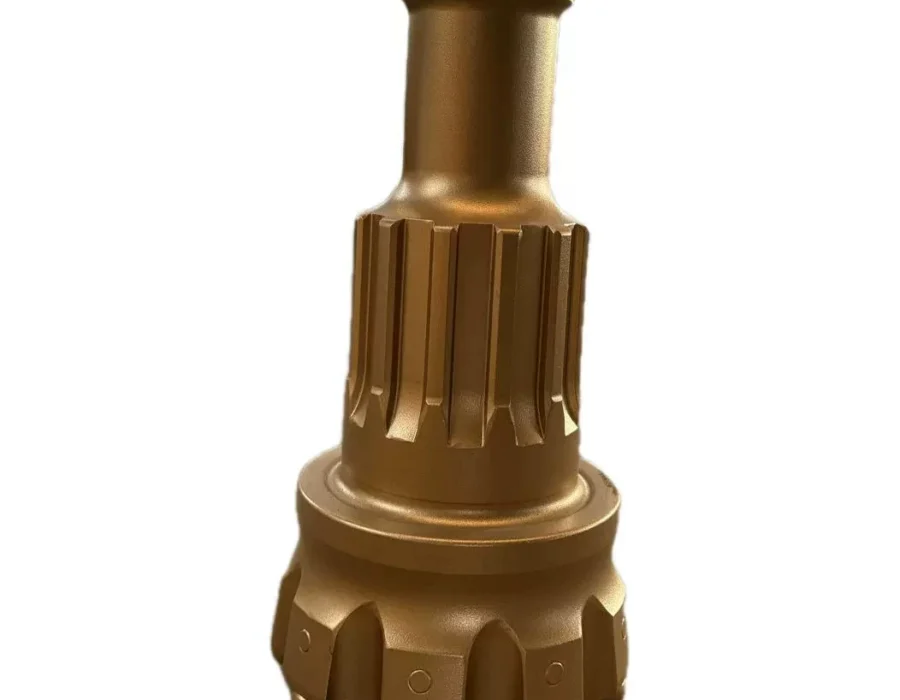
Hard granite at 15,000–30,000 psi favors DTH button or hard-formation insert tricone equipment in geothermal drilling. Select the structure from the logged interval, keep DTH within 25–60 RPM and tricone within 60–120 RPM, and plan for formation transitions rather than treating an entire geothermal hole as uniform hard rock.
Why does a geothermal profile need interval-based selection?
A geothermal bore may cross well-cemented sedimentary rock before entering granite or another strong basement unit. Consolidated formation describes well-cemented sedimentary material. Medium formation spans 4,000–15,000 psi and includes sandstone, limestone, and dolomite. Hard formation spans 15,000–30,000 psi and includes granite, basalt, and quartzite. Each interval presents a different balance of crushing resistance, impact response, and wear.
Button DTH and insert tricone are the stated geothermal choices. DTH is compatible with Medium, Hard, and Abrasive rock. Tricone covers all formations when the IADC cutting structure is correct. Insert 437 or 447 serves Medium; 537 or 547 serves Medium-Hard; 637 is the Hard code. A Soft milled-tooth code must not be carried into granite simply because it drilled the upper section efficiently.
The consolidated formation selection reference supports the upper sedimentary decision. When the profile approaches basement, use the hard rock bit requirements to check the 15,000–30,000 psi boundary and named lithologies. This interval approach gives the crew a defined reason to change structure.
How do DTH and tricone operating ranges differ?
DTH button drilling uses 1,000–3,000 lbf/in of diameter WOB, 25–60 RPM, and 0.7–2.4 MPa air pressure. Impact is the primary rock-breaking action. Rotation is deliberately modest because it indexes the buttons rather than providing high-speed shearing. In competent geothermal rock, stable seating and effective removal should be confirmed before settings move upward.
Tricone drilling uses 3,000–8,000 lbf/in WOB and 60–120 RPM. Insert teeth suit Medium through Hard conditions according to the selected IADC code. No tricone flow value is present in the authorized table, so circulation must be defined by the geothermal drilling program. Copying the PDC 250–650 gpm figure would be incorrect because that figure is tied to an 8.5-inch-class PDC case.
| Geothermal rock stage | Strength or character | Bit structure | Verified mechanical range |
|---|---|---|---|
| Cemented sedimentary interval | Consolidated | Tricone by IADC | 3,000–8,000 lbf/in; 60–120 RPM |
| Sandstone, limestone, dolomite | Medium; 4,000–15,000 psi | DTH or insert 437/447 | DTH: 1,000–3,000 lbf/in of dia; 25–60 RPM |
| Granite, basalt, quartzite | Hard; 15,000–30,000 psi | DTH or insert 637 | DTH air: 0.7–2.4 MPa |
What happens at a strong-rock transition?
Penetration may fall as the bit enters stronger rock, but the response should not be corrected by load alone. Confirm the lithology, watch torque and vibration, and inspect return character. If a Medium insert structure reaches a Hard interval, moving to code 637 addresses the structural mismatch. If DTH remains selected, settings must stay within the stated button envelope while impact and cleaning are evaluated.
Abrasion can cross strength boundaries. More than 20% quartz makes any interval Abrasive. The abrasive formation control points should therefore be reviewed even when UCS data labels the rock Medium. Gauge protection and inspection frequency become relevant, but no fixed service-life claim can be made from the available facts.
DTH also has a limitation in broken or loose ground. It is intended for Medium, Hard, and Abrasive formations, not unconsolidated alluvium. Where the hole loses competent contact, the drilling method and bore-control plan need reassessment. Additional air pressure within 0.7–2.4 MPa does not convert mobile material into a stable impact face.
Which failure evidence should change the plan?
Chipped buttons suggest shock concentration or unstable engagement. Fast gauge wear points toward abrasive contact, especially when quartz exceeds 20%. A tricone that wears unevenly may be mismatched to the formation or mechanically loaded off-center. Poor advance with excessive recutting indicates that removal deserves attention before the cutting structure is blamed.
Use a depth-linked record. Note the IADC code or button connection, WOB, RPM, air setting where applicable, returned lithology, and the location of visible wear. A statement such as “slow in hard rock” is too broad to guide the next run. “Granite entered within the 15,000–30,000 psi class while using a Medium insert structure” identifies a decision point.
Geothermal background is available through ScienceDirect Topics on geothermal energy. Geological maps and rock information can be reviewed at the U.S. Geological Survey. Neither source replaces the project bore log or the authorized bit parameter limits.
Gauge measurements belong in the same record. A bit can keep advancing after the outer row has lost diameter, leaving a hole that restricts the following assembly. Compare several points around the recovered face and note any one-sided loss. That evidence separates formation abrasion from alignment or feed problems.
How is the run recommendation finalized?
Write one selection line for each expected interval. Name the formation class, lithology, bit family, cutting structure or IADC code, connection, and parameter envelope. For DTH, include 1,000–3,000 lbf/in of diameter, 25–60 RPM, and 0.7–2.4 MPa. For tricone, include 3,000–8,000 lbf/in and 60–120 RPM plus the formation-matched code.
Add a change trigger. Granite or basalt entering the Hard range can trigger a move to insert 637. Quartz above 20% triggers an Abrasive designation. Loss of competent contact can invalidate the DTH assumption. These statements make the recommendation testable and expose its limits before the assembly reaches depth.