Unconsolidated gravel calls for a different water well bit strategy than 4,000–15,000 psi sandstone. Use drag bits only in soft or unconsolidated ground, tricone across formations with the correct IADC structure, and DTH button bits where medium or hard rock needs impact energy. Adjust parameters when returns or penetration behavior changes.
What does the bore log say about the first bit?
A water well often crosses more than one drilling condition before reaching target depth. Unconsolidated formation means uncemented alluvium or gravel. Consolidated formation is well-cemented sedimentary rock. Medium formation covers 4,000–15,000 psi UCS and includes sandstone, limestone, and dolomite. These labels are operational, because a cutting structure that moves loose alluvium effectively may stall or suffer wear after entering cemented rock.
Drag bits are limited to Soft–Medium service and are specifically compatible with soft or unconsolidated ground. They rotate at 100–250 RPM with low WOB. The phrase “low WOB” must remain qualitative because no numerical drag loading range is authorized. A drag design can be efficient in clay or loose material, but it is not suitable for hard formation and should not be kept downhole merely to avoid a trip.
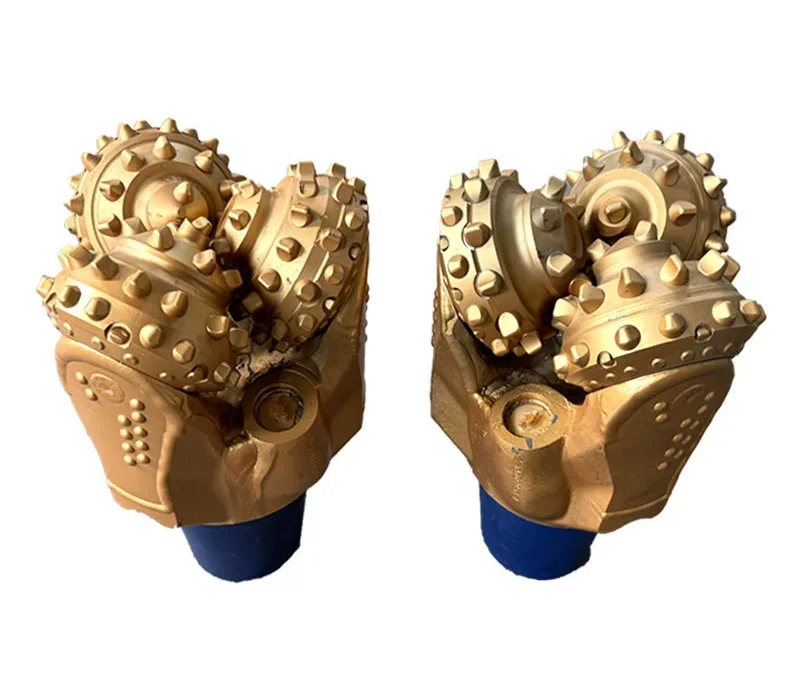
Tricone provides the broadest formation coverage. Milled-tooth IADC 111, 121, or 131 suits Soft material. Insert 437 or 447 addresses Medium rock, 537 or 547 covers Medium-Hard, and 637 is reserved for Hard. Before selecting a code, compare the bore log with the unconsolidated drilling conditions and the consolidated rock criteria.
Where do DTH button bits belong in a well program?
Button and DTH bits fit Medium, Hard, and Abrasive formations. Their stated operating window is 1,000–3,000 lbf/in of diameter WOB, 25–60 RPM, and 0.7–2.4 MPa air pressure. Impact provides the main breaking action, so rotary speed remains lower than the 100–250 RPM drag range. DTH is a strong option after the hole enters competent rock that no longer responds to scraping.
The limitation is equally clear: a DTH button bit is not a loose-gravel stabilizer. In unconsolidated alluvium, bore stability and removal of mobile particles can govern progress. Bit selection cannot substitute for an appropriate well-construction and circulation plan. Move to DTH because the formation requires impact, not because its buttons appear more durable.
| Water-well interval | Permitted bit path | Rotation reference | Load or air reference |
|---|---|---|---|
| Soft or Unconsolidated | Drag | 100–250 RPM | Low WOB |
| Any formation by structure | Tricone | 60–120 RPM | 3,000–8,000 lbf/in WOB |
| Medium, Hard, or Abrasive | Button/DTH | 25–60 RPM | 1,000–3,000 lbf/in of dia; 0.7–2.4 MPa |
How should the driller react at a formation change?
Use cuttings, penetration response, torque, and return behavior to identify a transition. When a drag bit leaves soft material and meets cemented sandstone, extra load is not a substitute for a compatible structure. When a DTH bit leaves hard rock and enters mobile gravel, continuing the same air-and-impact approach may aggravate instability. A planned bit change protects the bore and keeps the parameter record meaningful.
For Medium rock, the medium formation operating summary provides the 4,000–15,000 psi boundary and relevant lithologies. If tricone is selected, 437 or 447 is the allowed Medium insert range; 537 or 547 belongs to Medium-Hard. Do not promote the code solely because penetration slows. Confirm the rock description first.
Parameter changes should be small enough to interpret. For tricone, remain within 3,000–8,000 lbf/in WOB and 60–120 RPM. For DTH, stay within 1,000–3,000 lbf/in of diameter, 25–60 RPM, and 0.7–2.4 MPa. For drag, retain low WOB and 100–250 RPM. No approved water-flow number is provided for these water-well combinations, so a site hydraulic design must supply it.
Which wear signs point to the wrong tool?
A drag bit that stops cutting cleanly in cemented rock is outside its productive zone. Broken or heavily shocked buttons can indicate poor contact, unsuitable loose material, or unstable operation. A tricone with a Soft milled-tooth structure will not become a Hard-rock bit when WOB is increased. Premature wear should prompt comparison of the dull condition with the logged formation boundary.
Cleaning failures can resemble structural failure. Packed clay around a cutting face restricts new rock contact. Large mobile fragments can disturb steady loading. In competent rock, inadequate removal allows recutting and unnecessary wear. Diagnose the return stream alongside the bit condition; do not assign every performance loss to cutter quality.
The National Ground Water Association provides water-well industry references. Geological context can be checked through the U.S. Geological Survey. These sources support planning, while the bit ranges used here remain limited to the approved operating data.
How can a mixed-ground well plan remain auditable?
Build the plan by interval. List the expected formation class, candidate bit, allowed parameter window, and the observation that triggers a change. For loose alluvium, identify Drag with low WOB and 100–250 RPM. For a Medium tricone section, identify the chosen 437 or 447 structure plus 3,000–8,000 lbf/in and 60–120 RPM. For hard DTH work, record the button range and air-pressure limits.
Keep unsupported figures out of the record. The available data supplies DTH air pressure but not a universal water flow for drag, tricone, or button drilling. Pump selection, bore diameter, and return requirements need a project-specific hydraulic calculation. That limitation is more useful than a borrowed flow number because it clearly separates verified bit guidance from well-design engineering.