
Product Description
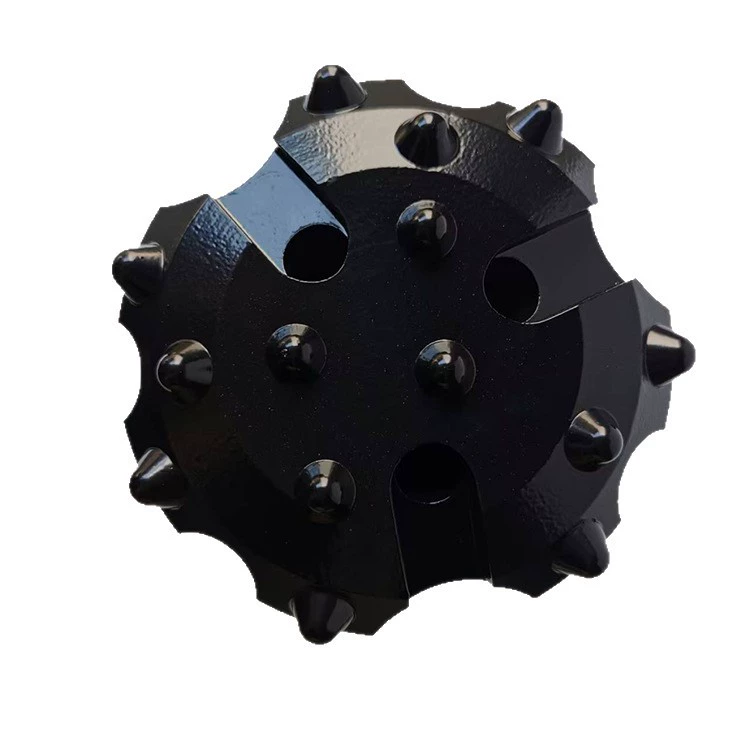
The 130 mm CIR110 ball-tooth DTH bit is intended for hard-rock water wells, mine holes, and construction drilling where a CIR110 hammer class is installed. Its 5.12-inch gauge provides a larger bore than compact CIR90 tooling while retaining down-the-hole impact at the face. Check the program through the water well drilling application archive and classify the rock with the hard formation archive. It does not replace casing where overburden or fractured zones cannot remain open.
The source identifies CIR110, 130 mm, and carbide ball teeth. The record therefore specifies an alloy-steel DTH body with fixed rounded carbide buttons and a CIR110 shank family. It does not supply spline dimensions, retaining details, face type, button count, or port area. “High efficiency” in the source is not converted into a penetration claim. Verify the exact hammer interface, foot-valve requirement, gauge diameter, and flushing passages before assembly, particularly when the hammer and bit originate from different dimensional standards.
Use 1,000–3,000 lbf/in of diameter, 25–60 RPM, and hammer-approved air within the referenced 0.7–2.4 MPa button/DTH pressure range. Hard and abrasive rock are the main targets; unstable gravel or heavily broken zones require bore support and may interrupt steady impact contact. Measure the finished bore before selecting any following casing or screen assembly. Flow is blank because air pressure does not define compressor volume at depth. The limitation is that CIR110 names a family but not every fit dimension. Water-well technical resources are available from the National Ground Water Association.