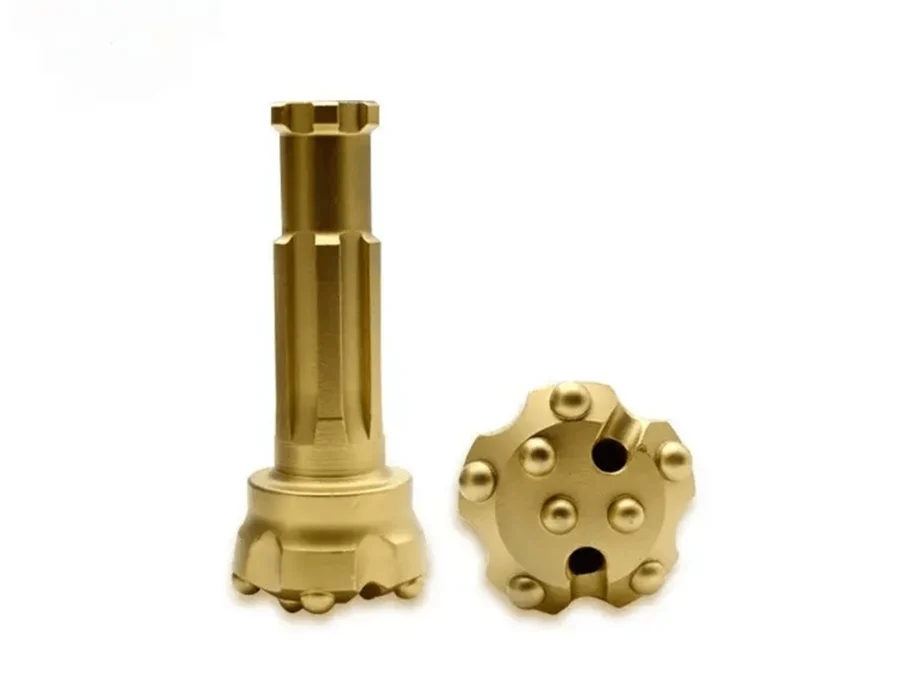
A 42mm button bit suits construction holes in 4,000–15,000 psi sandstone, limestone, or dolomite, while harder granite and abrasive quartz-rich rock demand the same impact family with closer wear control. Keep button operation at 1,000–3,000 lbf/in of diameter, 25–60 RPM, and 0.7–2.4 MPa air pressure.
Which site conditions define the starting bit?
Construction drilling can include anchors, blast holes, slope support, foundation investigation, and utility access. The task changes, yet the bit still meets a specific formation. Medium formation occupies the 4,000–15,000 psi band; representative rocks are sandstone, limestone, and dolomite. Hard formation has UCS of 15,000–30,000 psi and includes granite, basalt, and quartzite. Abrasive status applies whenever quartz content exceeds 20%.
Button bits are compatible with Medium, Hard, and Abrasive ground. Their impact action suits competent rock encountered in tunnel, quarry, and civil works. Drag bits can serve Soft–Medium conditions, especially Soft or Unconsolidated material, but they are not a substitute for buttons in granite. The selection should follow the actual rock face or site investigation rather than a broad project label such as “foundation work.”
For a cemented sandstone interval, consult the medium formation drill-bit factors. Where granite or basalt is named, use the hard formation selection boundary. The two classifications separate a 4,000–15,000 psi response from a 15,000–30,000 psi response and give the field team a clear basis for changing tools.
How should a button bit be operated on a civil site?
The authorized button/DTH range is 1,000–3,000 lbf/in of diameter WOB, 25–60 RPM, and 0.7–2.4 MPa air pressure. Impact performs most of the fracture work. Rotation moves the inserts to new contact points and supports even coverage. Start with stable engagement and clear returns before moving toward a higher setting inside the window.
R32, R38, T38, T45, T51, and GT60 identify top-hammer thread families. Connection must match the rod system and rig. A correct R32 or T45 connection does not establish rock compatibility; button design and formation assignment still require review. Likewise, a suitable button face cannot compensate for a thread that does not fit the string.
| Civil drilling condition | Rock definition | Bit-family decision | Controlled setting |
|---|---|---|---|
| Sandstone, limestone, dolomite | Medium; 4,000–15,000 psi | Button; Drag only within Soft–Medium limit | Button: 25–60 RPM |
| Granite, basalt, quartzite | Hard; 15,000–30,000 psi | Button/DTH | 1,000–3,000 lbf/in of dia |
| Any rock above 20% quartz | Abrasive | Button/DTH with wear monitoring | 0.7–2.4 MPa air pressure |
Why can two medium-strength rocks wear a bit differently?
UCS and abrasiveness describe separate properties. Limestone and quartz-rich sandstone may both sit inside the Medium range, yet the sandstone can cross the Abrasive threshold when quartz exceeds 20%. That difference affects gauge wear and insert condition. Do not infer abrasive behavior solely from the strength class or assume every 4,000–15,000 psi interval will produce the same dull pattern.
The abrasive rock drilling notes provide the quartz criterion. On site, track visible lithology, returned particles, penetration response, and gauge condition. A stable penetration rate with rapid peripheral loss still signals a wear problem. A low rate without severe wear may instead point to energy transfer or cleaning.
No fixed bit-life figure is supported. Footage depends on the actual rock sequence, flushing, impact delivery, and handling. Avoid promises tied to a named lithology alone. The defensible statement is that quartz above 20% raises the abrasive classification and requires inspection appropriate to that risk.
What common failures indicate a selection error?
Button chipping can follow unstable seating, broken ground, or concentrated shock. Uneven face wear may indicate poor contact or irregular rotation. Gauge loss is consistent with abrasive exposure. Packed cuttings and repeated grinding point toward inadequate removal. A drag profile that stops advancing in strong cemented rock has reached its formation limit, and extra WOB is not a sound correction.
Keep a short change log for WOB, RPM, and air pressure. Change one control at a time where practical, then observe the response. Remain within 1,000–3,000 lbf/in of diameter, 25–60 RPM, and 0.7–2.4 MPa for button/DTH. The data gives no liquid-flow range for this construction case, so a project flushing plan must define water delivery.
Rock and geotechnical context can be reviewed through ScienceDirect rock-mechanics topics. Site geology references are available from the U.S. Geological Survey. Field observations still control the final interval assignment.
Connection checks should distinguish cutting diameter from rod thread. R32, R38, T38, T45, T51, and GT60 identify top-hammer interfaces, not finished hole size. Confirm both values on the selected tool. A correct carbide face on the wrong rod system creates movement that can look like a formation problem.
How is a construction bit plan checked before drilling?
List the hole purpose, expected lithology, formation class, bit family, diameter or thread, and operating window. A Hard granite entry should identify Button/DTH, 15,000–30,000 psi, 1,000–3,000 lbf/in of diameter, 25–60 RPM, and 0.7–2.4 MPa. A Medium sandstone entry should also state whether quartz exceeds 20%.
Add the exclusion beside the selection. Drag is limited to Soft–Medium and should not be specified for Hard rock. Button/DTH is not assigned to Unconsolidated formation. This check protects against carrying a valid bit into an invalid interval and gives the crew an observable trigger for a tool change. Measure the recovered gauge after drilling.