
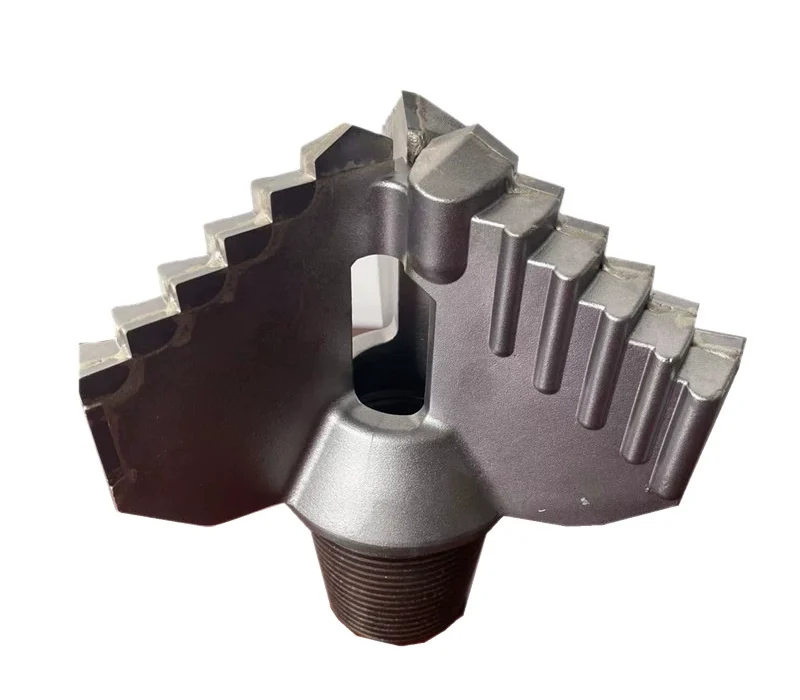
Use PDC for efficient shearing in clay, shale, and other soft rock below 4,000 psi when the interval is consolidated enough for stable cutter engagement. Run 2,000–10,000 lbf/in WOB and 60–300 RPM, with 250–650 gpm for an 8.5 in hole. Choose a milled-tooth tricone when rolling action better handles variability.
Soft oil and gas formations can drill quickly, but rapid penetration creates its own control problems. Clay and shale can pack cutters. Unconsolidated sand can destabilize the face. A bit that takes too deep a cut may build torque or create poor directional response. The choice between PDC and tricone therefore depends on how the soft rock is bonded, how it cleans, and how stable the assembly remains at useful penetration.
Why does PDC usually lead in soft rock?
PDC cutters shear rather than crush. In cohesive soft rock, that action can maintain continuous engagement and produce an efficient cutting path. The body and blade layout should keep cuttings moving away from the face. A stable PDC run also supports oil and gas applications where toolface response matters. Use the soft formation archive to confirm the less-than-4,000 psi class, and the oil and gas drilling archive to keep the operational context attached.
The limitation is material stability. PDC is not suitable for gravel under the supplied compatibility table. Loose clasts can strike cutters and break the continuous shearing condition. Sticky clay can also ball the face even when strength is low. Soft does not mean trouble-free; cleaning and depth-of-cut control remain necessary.
How should PDC parameters be introduced?
Operate inside 2,000–10,000 lbf/in WOB and 60–300 RPM. For an 8.5 in hole, use the stated 250–650 gpm flow range. Start with a conservative combination and watch torque response. If a small WOB increase produces a large torque rise without proportional penetration, the cutters may be engaging too deeply or the face may be packing.
RPM can improve cutting frequency, but it also raises the amount of rock contacted per minute. Do not use 300 RPM as an automatic target. Flow inside the approved range must remove soft, potentially sticky cuttings from the blades. If pressure or returns indicate balling, reducing cutter loading while restoring cleaning is more defensible than forcing the bit.
| Soft-formation option | Allowed WOB | Allowed RPM | Other fact |
|---|---|---|---|
| PDC | 2,000–10,000 lbf/in | 60–300 | 250–650 gpm for an 8.5 in hole |
| Milled-tooth tricone | 3,000–8,000 lbf/in of diameter | 60–120 | IADC 111, 121, or 131 |
| Drag bit | Low WOB | 100–250 | Soft–Medium only; not the primary oil and gas choice here |
When does a milled-tooth tricone make sense?
A tricone is useful when rolling contact tolerates the interval better than fixed cutters or when the soft formation contains changes that create unstable PDC torque. Milled teeth are the approved structure for soft material. IADC 111, 121, and 131 are the permitted soft milled-tooth codes. Run 3,000–8,000 lbf/in of diameter and 60–120 RPM.
The tricone has bearings and moving cones, so solids control and condition monitoring matter. A packed cone or worn bearing can erase the benefit of rolling action. The fact table does not provide a tricone flow range; do not transfer the PDC 250–650 gpm figure to a different bit and hole reference without support.
Formation identification should be kept separate from apparent drillability. A soft shale may cut quickly but still smear across a PDC face. Uncemented sand may show low resistance while failing to support a clean shearing path. Record the returned material and bonding condition beside each parameter change so the next decision is not based only on instantaneous rate.
Bit cleaning at surface also matters for dull evaluation. Remove packed clay without damaging cutter edges, then inspect the nose, shoulder, and gauge separately. A clean face may reveal isolated chips that were hidden during the run. On a tricone, verify that each cone turns freely before attributing a slow interval entirely to formation strength.
Classification details can be checked through the IADC. General oilfield drilling concepts are available through PetroWiki. These sources do not change the fixed parameter ranges used in this dataset.
What failures are specific to soft drilling?
PDC balling appears as packed material around cutters and blades, rising torque, and falling penetration. Cutter wear may be modest while performance collapses because the face cannot clear. An aggressive response with more WOB can deepen the problem. Gravel impact is a different mechanism and may chip individual cutters.
Milled-tooth tricones can pack between teeth or around cones. Teeth may wear smooth if the interval contains more abrasive material than the soft label suggests. Quartz content above 20% defines an abrasive formation even when UCS is below 4,000 psi. That mineral change can shorten the useful life of either cutting system.
How is the final choice documented?
Record whether the soft interval was clay, shale, or uncemented sand. Note the bond condition because PDC compatibility includes soft, medium, and consolidated formations but excludes gravel. Link parameter changes to torque and return behavior. On recovery, document cutter cleaning, blade condition, cone freedom, teeth, and gauge.
PDC is the preferred shearing option for stable soft rock. A milled-tooth tricone is a credible alternative when rolling contact and soft-to-variable tolerance matter more. Neither selection excuses unsupported claims. The run plan should state the expected limitation, the approved operating window, and the observation that will trigger a change.