
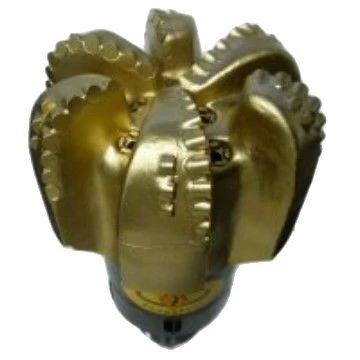
Consolidated formation means well-cemented sedimentary rock; it does not supply one UCS number. PDC and strength-matched tricone are primary rotary options, while Button/DTH can fit competent Medium or Hard sections. Identify sandstone, limestone, or dolomite, confirm strength and quartz status, and preserve gauge through verified cleaning and operating limits.
What does consolidated describe?
Consolidated refers to bonding: the sedimentary material is well cemented. The definition does not place every consolidated interval into one strength class. Cemented sandstone, limestone, or dolomite may fall in the 4,000–15,000 psi Medium range, while a stronger section may require a different structure. Quartz above 20% adds an Abrasive description without changing the bonding definition.
This distinction prevents a common selection error. A log entry marked “consolidated” supports PDC compatibility, but it does not identify an IADC tricone code by itself. The reviewer still needs lithology and strength. The 160 mm three-blade PDC product is relevant because PDC is explicitly compatible with Consolidated formation. The 120 mm insert tricone product supports a rolling route selected by strength.
How should strength refine the bit choice?
For Medium consolidated rock, PDC, tricone 437 or 447, and Button/DTH can each be considered when the application and rig support them. If the interval is Medium-Hard, tricone selection moves to 537 or 547. Hard rock requires 637 or a compatible Button/DTH system. PDC’s stated Consolidated compatibility remains useful, but the actual product must still be verified for the job; the broad taxonomy cannot certify an unknown cutter design.
Drag bits are limited to Soft–Medium and align most clearly with Soft or Unconsolidated ground. They should not be presented as the default for well-cemented rock merely because one consolidated interval tests within Medium UCS. That limitation is important in water-well or construction planning, where a simple scraping structure may fit overburden but not the cemented section below it.
| Consolidated-rock check | Approved classification fact | Candidate bit route | Operating reference |
|---|---|---|---|
| Well-cemented sandstone, limestone, or dolomite | 4,000–15,000 psi Medium class when measured there | Button/DTH, PDC, or tricone 437/447 | Use the selected family’s own envelope |
| Medium-Hard cemented interval | Above Medium assignment | Tricone 537/547 or compatible Button/DTH | Tricone: 3,000–8,000 lbf/in; 60–120 RPM |
| Hard competent interval | Hard class from 15,000 to 30,000 psi | Button/DTH or tricone 637 | DTH: air 0.7–2.4 MPa; 25–60 RPM; WOB 1,000–3,000 lbf/in |
| Quartz above 20% | Abrasive in addition to strength class | Retain compatible structure and raise wear attention | No fixed life claim is supported |
Cleaning and gauge in cemented sedimentary rock
Competent chips must leave the bottom before they are recut. PDC rotary speed is 60–300 RPM, with diameter-based WOB of 2,000–10,000 lbf/in; the only supplied liquid range is 250–650 gpm for an 8.5-inch-class PDC hole. Tricone uses 3,000–8,000 lbf/in and 60–120 RPM, but no circulation number is provided. Button/DTH carries 0.7–2.4 MPa pressure without a universal air-volume figure.
Gauge wear should be separated from wall instability. A tighter return trip in consolidated rock can result from peripheral cutter loss, settled cuttings, or an irregular hole. Inspect the recovered bit and note the character of returns. Fine material may indicate recutting; distinct cemented fragments can support effective breakage. Raising both WOB and RPM at once removes the ability to identify which control changed the response.
Cutting-structure condition should be logged by zone. On PDC, compare central cutters, shoulder, and gauge rather than reporting a single wear description. On a tricone, record tooth or insert condition together with cone tracking and the observed lithology. On Button/DTH equipment, separate face buttons from peripheral buttons and confirm that impact delivery remained steady. These observations show whether cemented chips, abrasive quartz, or unstable loading dominated the run.
Connection confirmation is necessary but cannot replace the formation review. A tool that fits the string may still carry a Soft structure into stronger cemented rock. Conversely, a Hard structure can drill inefficiently in a lower-strength interval if its contact pattern is unsuitable. The release sheet should place connection, strength class, quartz status, and operating mechanism on separate lines so each item receives an explicit approval.
Cuttings shape can strengthen that review. Cemented fragments that remain distinct suggest the bottom is being cleared before excessive recutting, while a shift toward fine material can justify a cleaning check. If torque changes at the same depth, preserve the sequence in the log. The combination of fragment character, mechanical response, and recovered gauge is more useful than any one observation viewed by itself.
How do oilfield, water-well, and geothermal plans vary?
Oil and gas drilling may use PDC shearing or an insert tricone selected from the formation strength. A water well can favor tricone across changing cemented lithologies or Button/DTH when a hard competent interval and suitable air system are present. Geothermal drilling may begin in consolidated sedimentary rock and later enter Hard basement, so the program should include a structure-change criterion.
The water-well application archive adds casing and bore-condition context to the formation choice. Even there, bit selection cannot guarantee wall stability or completion quality. A DTH tool is restricted when the rig cannot supply the required hammer and air, while a tricone plan remains incomplete until project hydraulics are defined.
What evidence should approve the next bit?
Capture the specific sedimentary lithology, UCS band, quartz status, bit identity, connection, controls, returned chips, and gauge condition. If a 437 or 447 tricone slows in a stronger cemented bed, verify that the formation moved beyond Medium before selecting 537/547 or 637. If wear concentrates at the perimeter, record that separately from face dulling.
For regional mapping and rock descriptions, consult the U.S. Geological Survey; water-well practice can be researched at the National Ground Water Association. The core limitation remains: “Consolidated” describes cementation, not a complete operating program. Strength, abrasiveness, mechanism, and rig capability must still be verified.