
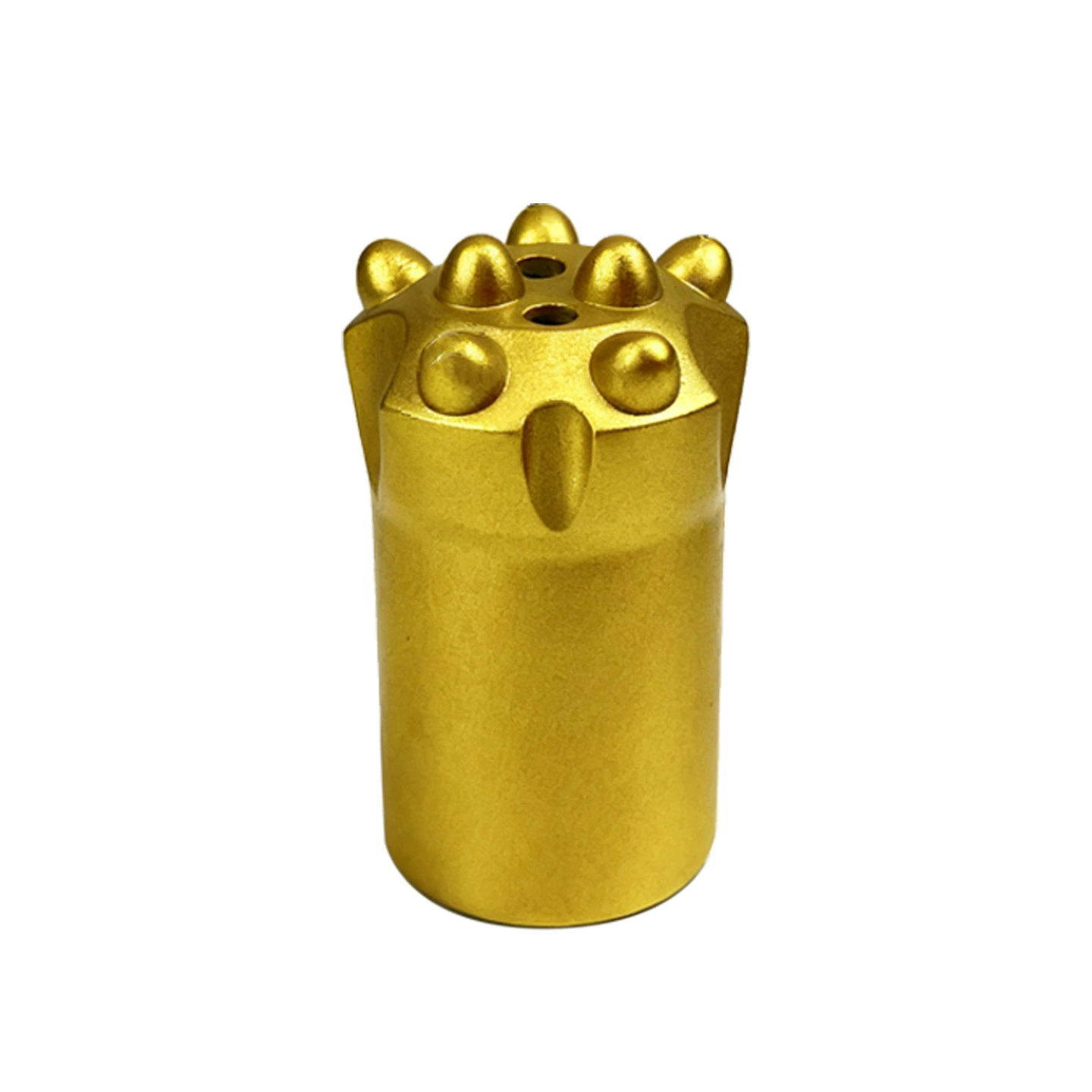
32 mm Seven-Tooth Button Bit for Mining Exploration

32 mm Seven-Tooth Button Bit for Mining Exploration

32 mm Seven-Tooth Button Bit for Mining Exploration

A 32 mm seven-tooth carbide button bit for narrow mining and geological probe holes in hard or abrasive rock reliably.

Request Pricing

Technical Specifications

Model / Series32-7T Exploration Button
Size Range (in / mm)32 mm (1.26 in)
Body Material (matrix / steel)Alloy steel body
Cutter / Insert / Tooth ConfigurationSeven carbide ball-tooth contacts
Blades / ConesSeven-tooth button face; distribution not stated
API ConnectionNot stated; verify drill rod interface
Circulation / Nozzle PortsCuttings-flushing passages; layout not stated
Bearing / Seal TypeNot applicable — fixed button structure
Recommended WOB1,000–3,000 lbf/in of dia
Recommended RPM25–60
Condition (new / rebuilt / rerun)New
Availability / Lead TimeShips from stock, subject to confirmation
SKU / Part NumberRDB-BTN-011

Product Description

This 32 mm seven-tooth button bit is intended for narrow mining rounds, geological probe holes, and underground excavation where a small gauge and distributed carbide face are useful. Seven contacts provide a more divided impact pattern than a four-tooth face, subject to the actual button layout. Define the work through the mining and exploration application archive and compare the interval with the hard formation archive. The bit is not a core-recovery tool and does not preserve an intact geological sample.

The source confirms a 32 mm gauge and seven-tooth carbide button construction. An alloy-steel body carries the fixed inserts, but the filename does not identify whether all seven contacts are face buttons or whether some support the gauge. Connection type, face recess, skirt length, carbide profile, and flushing-hole position are also unknown. Those details affect collaring and sample-return quality. Before using the bit for an exploration hole, confirm the rod interface and establish whether the face geometry meets the required deviation and cuttings objectives.

Use 1,000–3,000 lbf/in of diameter and 25–60 RPM. A 32 mm gauge produces a smaller total-load range than larger button bits, so calculate loading from the actual 1.26-inch diameter rather than copying a jumbo setting. Hard and abrasive formations are appropriate, but fractured ground can load the seven contacts unevenly. No flow value is stated; set flushing from the rod bore and desired cuttings transport. The limitation is that this is destructive drilling, not coring. Geological references are available from the U.S. Geological Survey.

Frequently Asked Questions

Can this seven-tooth bit recover geological core?

No. It is a destructive button bit that produces cuttings rather than an intact core. It can support probe or exploratory drilling where chip returns are acceptable, but projects requiring oriented or continuous core need a purpose-built coring system for analysis.

How should load be set for the 32 mm gauge?

Calculate total load from the approved 1,000–3,000 lbf/in of diameter window using the actual 1.26-inch gauge. Keep rotary speed between 25 and 60 RPM, start conservatively, and confirm that all contacts seat evenly before increasing mechanical input.

Request a Quote

Send your bit type, diameter, formation, connection and quantity to receive pricing and availability.

Request a Quote