
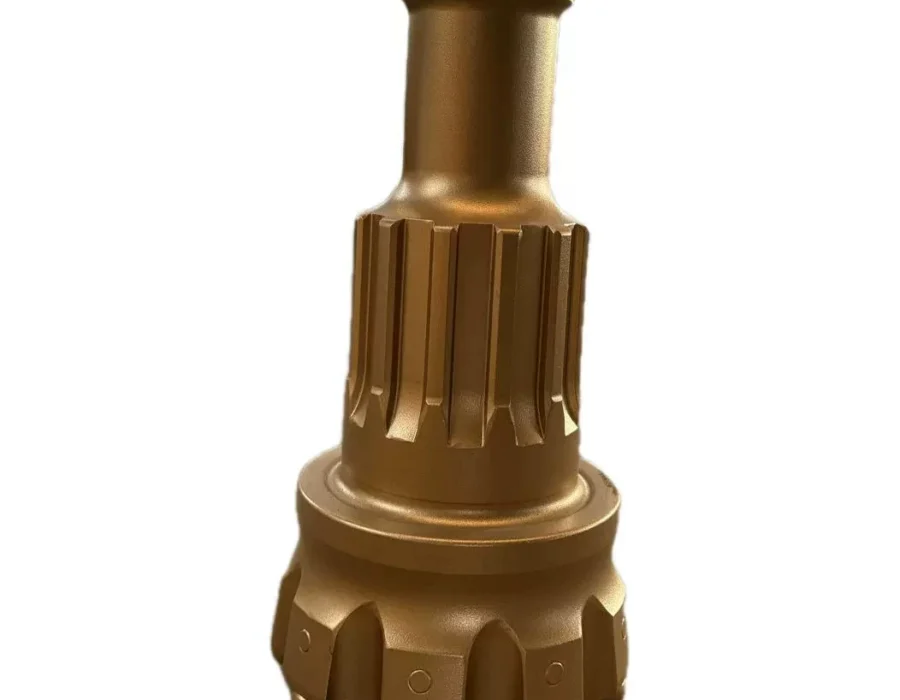
The Hard class runs from 15,000 to 30,000 psi UCS; granite, basalt, and quartzite are its named rocks. Button/DTH systems and IADC 637 insert tricones are the approved routes. Protect gauge, confirm impact or rolling contact, and do not extend PDC or drag compatibility merely because those tools fit a connection or hole diameter.
How is Hard formation defined for selection?
The Hard category begins at 15,000 psi and extends to 30,000 psi UCS. Granite, basalt, and quartzite are the listed lithologies. These rocks demand a cutting system capable of repeated high-contact loading. Strength does not automatically describe fracturing or quartz content, but it excludes structures assigned only to Soft or Medium work. A plan should identify the specific rock, not simply mark the interval “competent.”
Two approved paths dominate. Button/DTH bits are compatible with Hard formation and use percussion to create fracture under carbide contacts. Tricone code 637 is the insert structure assigned to Hard rock. The 45 mm R32 hard-rock button product supports impact-tool review, while the 120 mm insert tricone product provides the rolling alternative. Connection fit alone cannot choose between them.
Why do impact and rolling structures behave differently?
A Button/DTH assembly delivers breakage mainly through hammer impact. Rotation moves buttons toward fresh contact, which is why its approved rotary window is lower than the PDC or drag ranges. The face and peripheral buttons must share load well enough to preserve gauge. Chipped inserts, flat buttons, or rapid outer-row wear can identify unstable seating, poor energy transfer, or an abrasive component.
An IADC 637 tricone distributes crushing contact across three cones. It can suit a Hard interval where the drilling system is designed for roller-cone operation. The code is essential: 437 or 447 is Medium, and 537 or 547 is Medium-Hard. Raising WOB on one of those softer assignments does not transform it into a 637 structure. That is a structural limitation, not a parameter preference.
| Hard-rock route | Approved identity | Operating envelope | Primary exclusion |
|---|---|---|---|
| Button/DTH | Hard-compatible impact bit | 25–60 RPM; WOB 1,000–3,000 lbf/in of dia; air 0.7–2.4 MPa | Not assigned to Unconsolidated ground |
| Insert tricone | IADC 637 | 3,000–8,000 lbf/in; 60–120 RPM | No approved tricone flow number |
| PDC | Soft, Medium, or Consolidated only | Its published range does not authorize Hard use | Hard formation is outside stated compatibility |
| Drag | Soft–Medium only | Low WOB; 100–250 RPM within its own service | Not suitable for 15,000–30,000 psi rock |
Gauge retention, flushing, and energy transfer
Gauge control begins at the outer cutting row. A recovered bit that has lost diameter can make later passage difficult even if the face still breaks rock. In Button/DTH work, compare face wear with gauge-button wear and verify that 0.7–2.4 MPa air pressure reaches the hammer system as intended. The approved data gives pressure but no universal air-volume figure, so compressor delivery and hole cleaning remain project checks.
For the 637 tricone, stay inside 3,000–8,000 lbf/in and 60–120 RPM. Circulation still has to clear the bottom, but no tricone flow range is supplied. Fine returns can indicate recutting, whereas large angular pieces can support effective fracture. Neither pattern should be interpreted alone. Link returns to torque, advance, and the depth at which granite, basalt, or quartzite entered the hole.
Connection and hammer fit remain release checks, not formation evidence. A DTH bit must match its hammer, and a roller cone must match the rotary assembly, but neither mechanical fit proves that the face structure suits Hard rock. Before the run, identify the verified interface, the available pressure or circulation system, and the measurement used to confirm hole gauge. After the run, compare outer-row wear with central wear so a diameter problem is not hidden by an otherwise intact face.
Hard-rock changes should be deliberate because each adjustment carries high contact stress. If advance falls, first verify that cuttings are leaving the bottom and that impact or cone motion remains stable. Increase only one control inside the authorized range, then observe the result. A simultaneous rise in WOB and RPM can conceal the cause of chipping, tracking, or bearing distress.
How do mining, construction, and geothermal needs differ?
Mining exploration may prioritize a recognizable geological return and a verified top-hammer or DTH interface. Construction drilling can place more emphasis on repeatable hole gauge for anchors, blasting, or support. Geothermal work may encounter Hard basement after a consolidated sedimentary interval, making the transition depth central to the bit-change plan. The geothermal drilling application illustrates that sequence without changing the Hard operating data.
Button/DTH can serve all three applications when the rig supplies the required impact system. A 637 tricone can provide a rotary route where roller-cone equipment is appropriate. PDC and drag remain excluded by the supplied compatibility facts. The plan should say so directly: a familiar oilfield connection or a successful Medium-rock run cannot justify carrying those structures into Hard granite.
What evidence supports the next run?
Photograph the face and gauge, identify missing or flattened buttons, note cone condition, and tie each observation to lithology. A sudden drop in advance at 15,000 psi-class rock may be an expected formation transition; continued loss after a compatible bit is installed may instead involve cleaning or energy transfer. More than 20% quartz also adds an Abrasive classification, which should be tracked separately.
Regional rock descriptions can be researched through the U.S. Geological Survey, while IADC code references are available from IADC. These sources do not replace field evidence. A defensible recommendation names the Hard lithology, selects Button/DTH or 637 tricone, states the exact approved controls, and records the restriction against unsupported PDC or drag use.