
Product Description
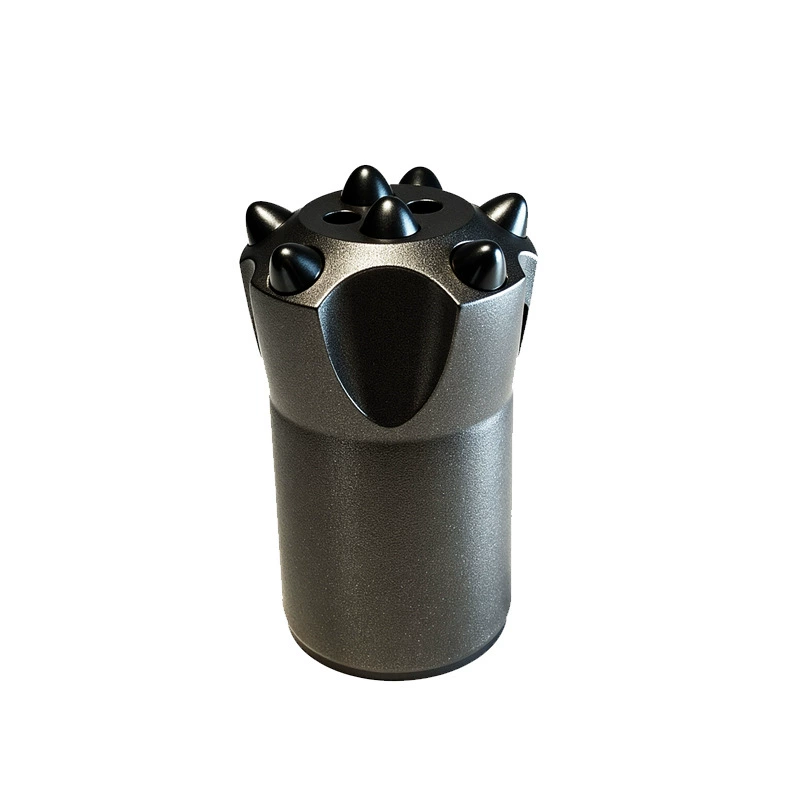
The 34 mm seven-tooth carbide button bit is intended for mining probes, tunnel investigation, and geological exploration holes where destructive chip samples are acceptable. Its 1.34-inch gauge offers a compact face for competent rock, while seven contacts distribute impact across the bore. Define the work through the mining and exploration application archive and compare quartz-related wear with the abrasive formation archive. The bit is not a core barrel and cannot provide an intact stratigraphic sample.
The source confirms 34 mm, seven teeth, carbide buttons, and mining, tunnel, and geological uses. The construction is stated conservatively as an alloy-steel body with seven fixed carbide contacts. It does not show whether the seven are divided between face and gauge positions, nor does it identify connection, face profile, skirt, or flushing holes. Those details influence deviation and sample transport. Verify the rod interface and face drawing before the bit is used for a hole where directional control or return quality is important.
Use 1,000–3,000 lbf/in of diameter and 25–60 RPM. Hard and abrasive formations suit impact drilling, but quartz-rich ground requires inspection of gauge loss and button flats. Fractured zones can disturb seating and produce misleading changes in penetration. Preserve depth-tagged cuttings and note flushing changes so geological interpretation is not based on penetration rate alone. Flow is blank because the rod bore and flushing path are not supplied. The explicit limitation is destructive sampling plus an unknown connection. Geological maps and rock information are available from the U.S. Geological Survey.