
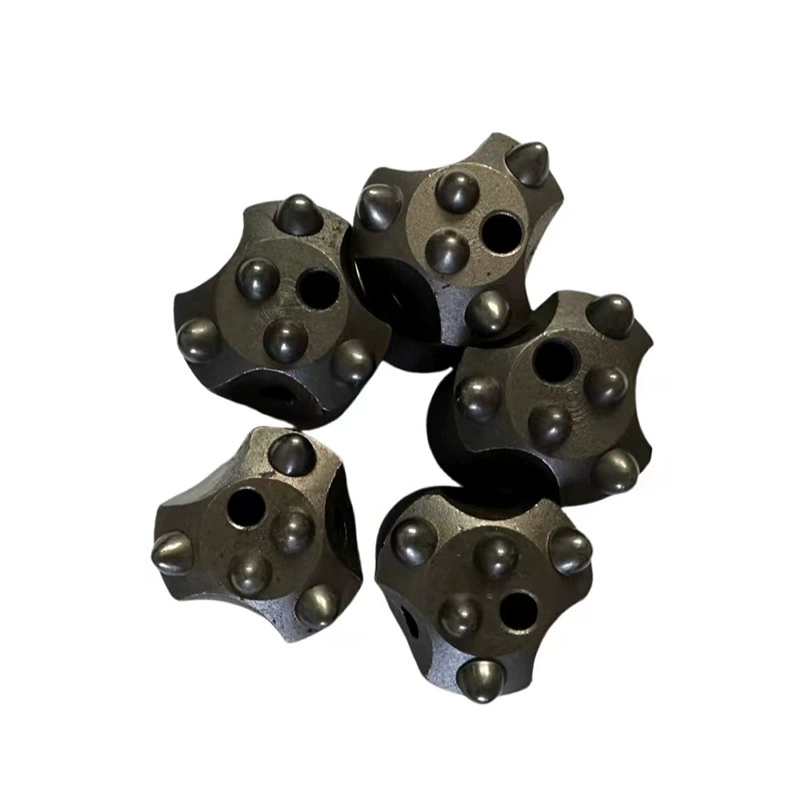
38–42 mm Six-Tooth Oblique-Hole Bit for Tunneling

38–42 mm Six-Tooth Oblique-Hole Bit for Tunneling

38–42 mm Six-Tooth Oblique-Hole Bit for Tunneling

A 38–42 mm six-tooth tapered button family with oblique flushing for tunnel rock drilling in hard formations safely.

Request Pricing

Technical Specifications

Model / Series38/40/42-6T Oblique
Size Range (in / mm)38–42 mm (1.50–1.65 in); listed 38, 40, and 42 mm
Body Material (matrix / steel)Cold-pressed alloy steel body
Cutter / Insert / Tooth ConfigurationSix carbide ball-tooth contacts
Blades / ConesSix-tooth face
API ConnectionTapered rod connection; dimensions not stated
Circulation / Nozzle PortsOblique flushing passages; exact port geometry not stated
Bearing / Seal TypeNot applicable — fixed button structure
Recommended WOB1,000–3,000 lbf/in of dia
Recommended RPM25–60
Condition (new / rebuilt / rerun)New
Availability / Lead TimeShips from stock, subject to confirmation
SKU / Part NumberRDB-BTN-013

Product Description

This six-tooth ball-button family references 38, 40, and 42 mm tunnel-drilling gauges and an oblique-hole face for use with a tapered drill-rod system. It is suited to development rounds and controlled rock excavation where angled flushing can help clear the contact zone. Review the task in the construction drilling application archive and compare the rock with the hard formation archive. The oblique-hole description does not make the bit suitable for directional steering or unconsolidated-ground control.

The source identifies six teeth, cold-pressed construction, a tapered rod, and the three gauge references. An alloy-steel body supports fixed carbide contacts, while the oblique-hole wording indicates angled flushing features rather than a guaranteed port number or orientation. The filename does not provide taper dimensions, actual face pattern by size, or whether all three gauges share the same six-tooth layout. Each variant must be checked for socket fit, insert arrangement, and port clearance before it is assigned to a drill.

Use 1,000–3,000 lbf/in of diameter and 25–60 RPM. Start with moderate settings because angled ports can only clean effectively when the rod passage and supplied air are compatible. Hard and abrasive rock may increase face and gauge wear; fractured contacts can cause one side of the six-tooth face to carry excess load. Inspect each angled passage whenever cuttings become finer or return volume falls. Flow is unspecified because no port area or compressor duty is given. The limitation is unverified taper and port geometry. Tunnel geology can be researched through the U.S. Geological Survey.

Frequently Asked Questions

What does oblique hole mean in this source description?

It indicates angled flushing features on the bit face, not a directional-drilling capability. The number, angle, and area of those passages are not supplied. Verify the actual port drawing and available rod flow before relying on the feature for cuttings removal.

Are all 38, 40, and 42 mm variants confirmed as identical?

No. The filename groups the three gauges with a six-tooth concept, but it does not prove identical taper dimensions, face spacing, or ports. Treat each size as a separate fit and geometry check before applying the common WOB and RPM window.

Related Drill Bits

Request a Quote

Send your bit type, diameter, formation, connection and quantity to receive pricing and availability.

Request a Quote