
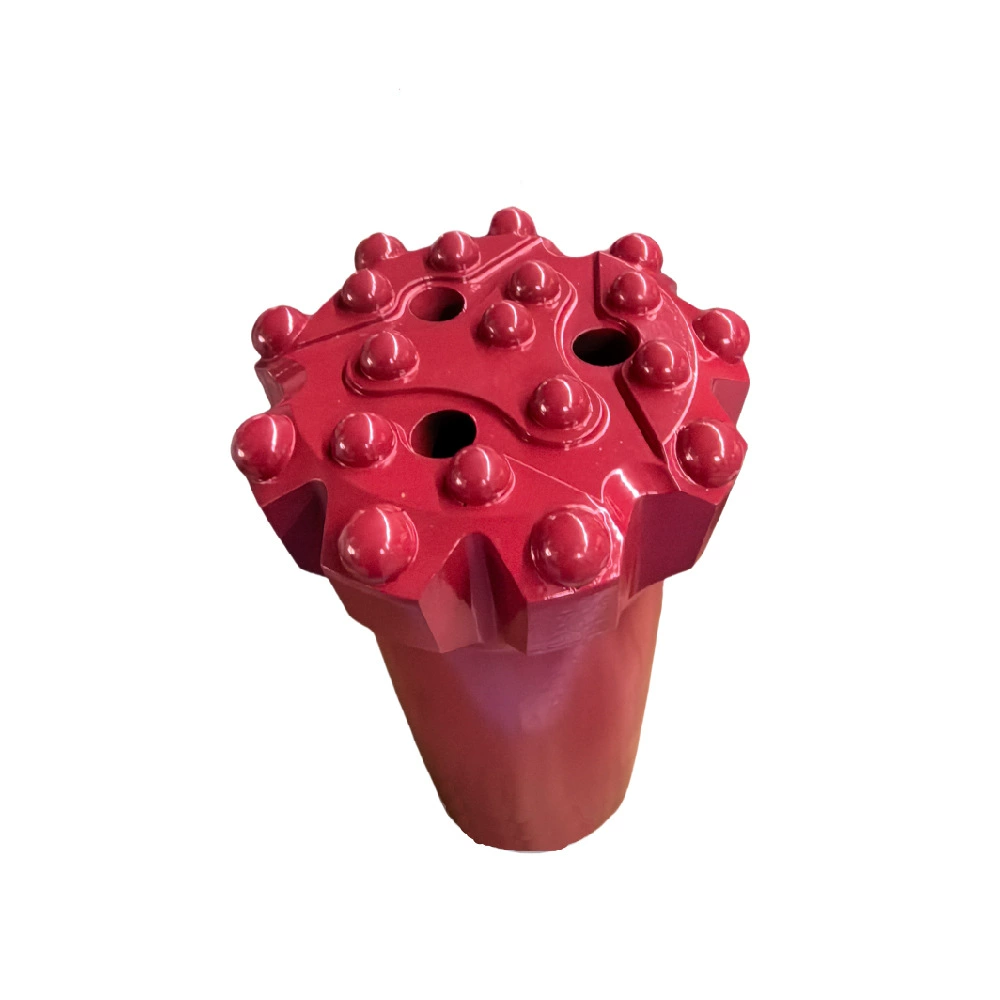
89–102 mm GT60 Thread Button Bit for Tunnel Drilling

89–102 mm GT60 Thread Button Bit for Tunnel Drilling

89–102 mm GT60 Thread Button Bit for Tunnel Drilling

GT60 threaded carbide button bits in 89 and 102 mm gauges for hydraulic tunnel and mining rock drills in competent rock.

Request Pricing

Technical Specifications

Model / SeriesGT60-89/102 Tunnel Series
Size Range (in / mm)89–102 mm (3.50–4.02 in); listed 89 and 102 mm
Body Material (matrix / steel)GT60 threaded alloy steel body
Cutter / Insert / Tooth ConfigurationCarbide buttons; count varies by unverified gauge
Blades / ConesButton face; size-specific profile required
API ConnectionGT60
Circulation / Nozzle PortsSize-specific face flushing not stated
Bearing / Seal TypeNot applicable — fixed button structure
Recommended WOB1,000–3,000 lbf/in of dia
Recommended RPM25–60
Condition (new / rebuilt / rerun)New
Availability / Lead TimeShips from stock, subject to confirmation
SKU / Part NumberRDB-BTN-023

Product Description

The GT60 thread button family references 89 and 102 mm gauges for hydraulic tunnel drills and large mining rounds. At approximately 3.50 and 4.02 inches, these diameters suit mechanized equipment with the impact capacity and rod system required by GT60 tooling. Review the work in the construction drilling application archive and compare the interval with the hard formation archive. The family is not intended for unsupported soil, and GT60 alone does not confirm the face geometry.

The source names a GT60 hydraulic thread, an 89 button-bit reference, and a 102 ball-tooth reference. This record treats them as two size variants within one threaded alloy-steel family with fixed carbide buttons. It does not assume that the 89 and 102 mm faces use the same insert count, profile, skirt, or flushing arrangement. GT60 connection details must still match the rod and shank adapter drawings. Confirm the exact model, gauge, button distribution, and porting before moving either variant into a drill plan.

Use 1,000–3,000 lbf/in of diameter and 25–60 RPM, calculating total load separately for 89 and 102 mm. Hard and abrasive formations are appropriate; larger faces require effective removal to avoid recutting and peripheral wear. Track return velocity and gauge wear separately for the two listed diameters. Flow is blank because rod bore, port area, hole depth, and flushing medium are unverified. The explicit limitation is that only two gauges and one thread family are known, not a complete face specification. Drilling-system information can be reviewed through the IADC.

Frequently Asked Questions

Are the 89 mm and 102 mm faces confirmed to be identical?

No. They share a GT60 family reference, but button count, face profile, skirt, and flushing ports can differ with diameter. Obtain a drawing for the exact 89 mm or 102 mm model rather than scaling details from the other variant.

How does the operating load change between the two gauges?

Both use 1,000–3,000 lbf/in of diameter, so total load is calculated from the selected gauge. The 102 mm bit requires a different total-force calculation from the 89 mm bit. Keep both within 25–60 RPM and confirm stable flushing.

Related Drill Bits

Request a Quote

Send your bit type, diameter, formation, connection and quantity to receive pricing and availability.

Request a Quote