
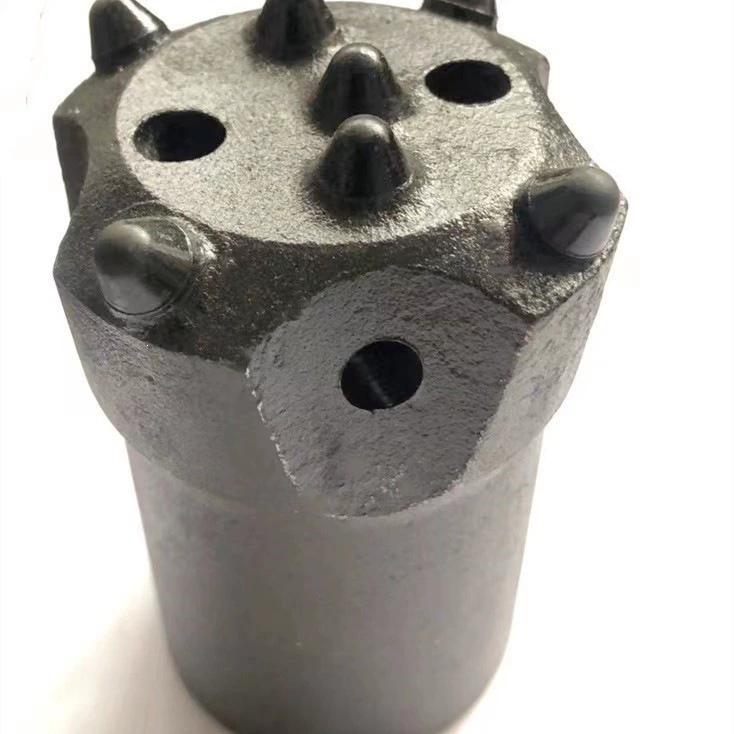
T38/R38 Heat-Inserted Multi-Button Bit for Mining

T38/R38 Heat-Inserted Multi-Button Bit for Mining

T38/R38 Heat-Inserted Multi-Button Bit for Mining

A heat-inserted multi-button family for separate T38 or R38 mining systems, with actual hole gauge confirmed per model.

Request Pricing

Technical Specifications

Model / SeriesT38/R38 Heat-Inserted Series
Size Range (in / mm)T38 or R38 nominal 38 mm class (about 1.50 in); hole gauge not stated
Body Material (matrix / steel)Threaded carbide-steel body
Cutter / Insert / Tooth ConfigurationHeat-inserted carbide ball buttons; count not stated
Blades / ConesMulti-button face; profile not stated
API ConnectionSeparate T38 or R38 models
Circulation / Nozzle PortsModel-specific flushing arrangement not stated
Bearing / Seal TypeNot applicable — fixed button structure
Recommended WOB1,000–3,000 lbf/in of dia
Recommended RPM25–60
Condition (new / rebuilt / rerun)New
Availability / Lead TimeMade to order
SKU / Part NumberRDB-BTN-022

Product Description

The T38/R38 heat-inserted multi-button bit is intended for mine headings, quarry holes, and civil rock drilling with a nominal 38 mm thread class, approximately 1.50 inches. T38 and R38 describe different thread profiles even though their nominal number is the same. Place the job within the construction drilling application archive and assess wear through the abrasive formation archive. The record represents separate connection options and does not imply that one bit fits both rods.

The source states threaded construction, heat-inserted ball teeth, a multi-button carbide-steel face, and T38-R38 references. This supports a threaded alloy-steel body with fixed carbide inserts installed by the stated process. The filename does not identify the finished hole gauge, button count, face profile, skirt form, or flushing ports. Heat insertion is not converted into a retention or life guarantee. Confirm whether the selected model is T38 or R38, then verify gauge, shoulder, face geometry, and impact compatibility from a drawing.

Use 1,000–3,000 lbf/in of actual bit diameter and 25–60 RPM after the missing gauge is established. Hard and abrasive rock are suitable, but thread heating, insert movement, or uneven gauge wear calls for inspection. Because the hole gauge is absent, no total load should be calculated until the exact model is measured and documented. Flow is blank because the source provides no bit diameter, rod bore, or port data. The explicit limitation is that nominal thread class cannot substitute for hole-gauge information. General rock-mechanics background is available from the ScienceDirect engineering topics.

Frequently Asked Questions

Are T38 and R38 interchangeable because both use 38?

No. They are different thread profiles within a similar nominal class. A T38 bit should not be installed on an R38 rod or the reverse. Confirm the selected connection drawing, shoulder, and rod condition before assembly or use in service.

Does heat insertion verify carbide retention strength?

No. It identifies the source construction method but gives no measured retention value, heat-treatment record, or service-life result. Product acceptance should rely on verified manufacturing documentation and inspection, not on an unsupported durability conclusion from the phrase by engineering review.

Request a Quote

Send your bit type, diameter, formation, connection and quantity to receive pricing and availability.

Request a Quote