
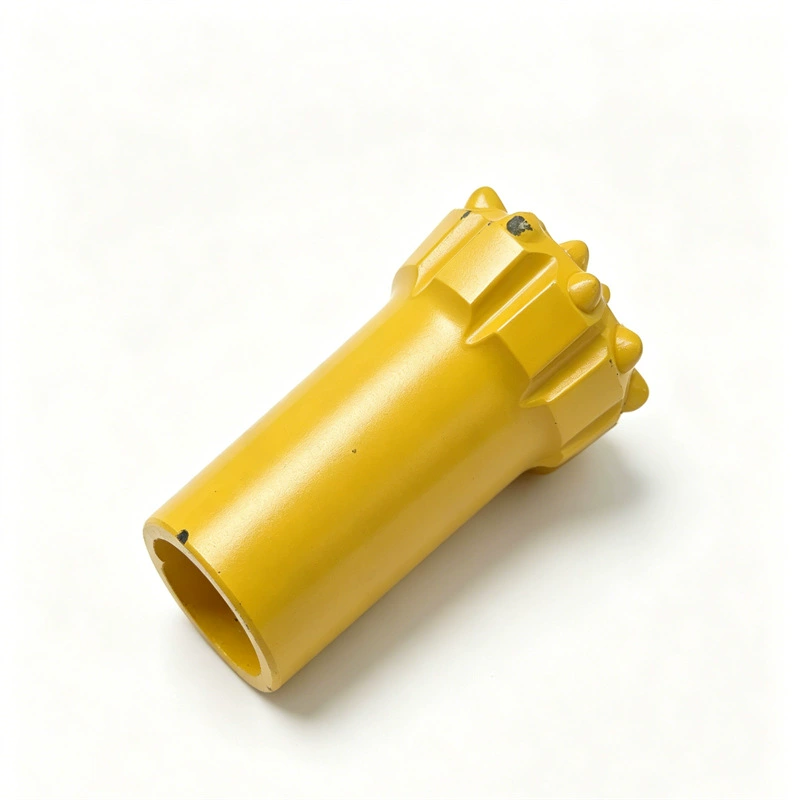
T38–T51 Non-Sticking Jumbo Button Bit for Tunneling

T38–T51 Non-Sticking Jumbo Button Bit for Tunneling

T38–T51 Non-Sticking Jumbo Button Bit for Tunneling

A T38–T51 threaded jumbo button-bit family for tunneling, with hole gauge, retrac profile, and flushing verified.

Request Pricing

Technical Specifications

Model / SeriesT38/T45/T51 Jumbo Series
Size Range (in / mm)T38–T51 nominal series, about 38–51 mm (1.50–2.01 in); hole gauge not stated
Body Material (matrix / steel)Threaded alloy steel jumbo body
Cutter / Insert / Tooth ConfigurationCarbide buttons; count and profile not stated
Blades / ConesJumbo button face; retrac profile not verified
API ConnectionT38, T45, or T51 by selected model
Circulation / Nozzle PortsModel-specific flushing arrangement not stated
Bearing / Seal TypeNot applicable — fixed button structure
Recommended WOB1,000–3,000 lbf/in of dia
Recommended RPM25–60
Condition (new / rebuilt / rerun)New
Availability / Lead TimeShips from stock, subject to confirmation
SKU / Part NumberRDB-BTN-019

Product Description

The T38, T45, and T51 jumbo-bit family is intended for tunnel boring support holes, development rounds, and mechanized mining where threaded top-hammer equipment is used. The nominal thread series spans roughly 38–51 mm, or 1.50–2.01 inches, but the source does not give the corresponding hole gauges. Review the task through the construction drilling application archive and the ground through the hard formation archive. It is not a tunnel-boring-machine cutter or a guarantee against binding.

The source describes high wear resistance and “non-sticking” behavior with T38, T45, and T51 connections. This record treats those phrases as intended design characteristics, not measured performance promises. The construction is a threaded alloy-steel jumbo bit with fixed carbide buttons. Hole diameter, face profile, retrac skirt, button count, and flushing-hole arrangement are not provided. Binding depends on hole condition, cuttings removal, gauge wear, alignment, and rod handling, so no bit can be represented as immune to sticking under all tunnel conditions.

Use 1,000–3,000 lbf/in of actual diameter and 25–60 RPM after the selected thread and hole gauge are confirmed. Hard and abrasive formations are appropriate; fractured zones or poor flushing can increase jamming risk despite the source wording. Monitor pullback torque because cuttings buildup can mimic a geometry problem. Flow remains blank because thread series alone does not define rod bore or required return velocity. The limitation is the missing diameter-to-thread matrix and absence of a verified anti-binding test. Rock-mechanics concepts can be reviewed through the ScienceDirect engineering topics. Measure gauge after every trial.

Frequently Asked Questions

Does non-sticking mean the bit cannot bind in a tunnel hole?

No. It is a source design descriptor, not a guarantee. Binding can result from gauge wear, fractured ground, cuttings buildup, alignment, or rod handling. Confirm the face and skirt design and maintain effective flushing rather than relying on the wording alone.

Do T38, T45, and T51 define the hole diameters?

No. They identify thread series with nominal numbers from about 38 to 51 mm, but the finished bit gauges are not stated. A size-specific drawing must map each connection to its actual diameter, face profile, and flushing layout before ordering.

Related Drill Bits

Request a Quote

Send your bit type, diameter, formation, connection and quantity to receive pricing and availability.

Request a Quote