
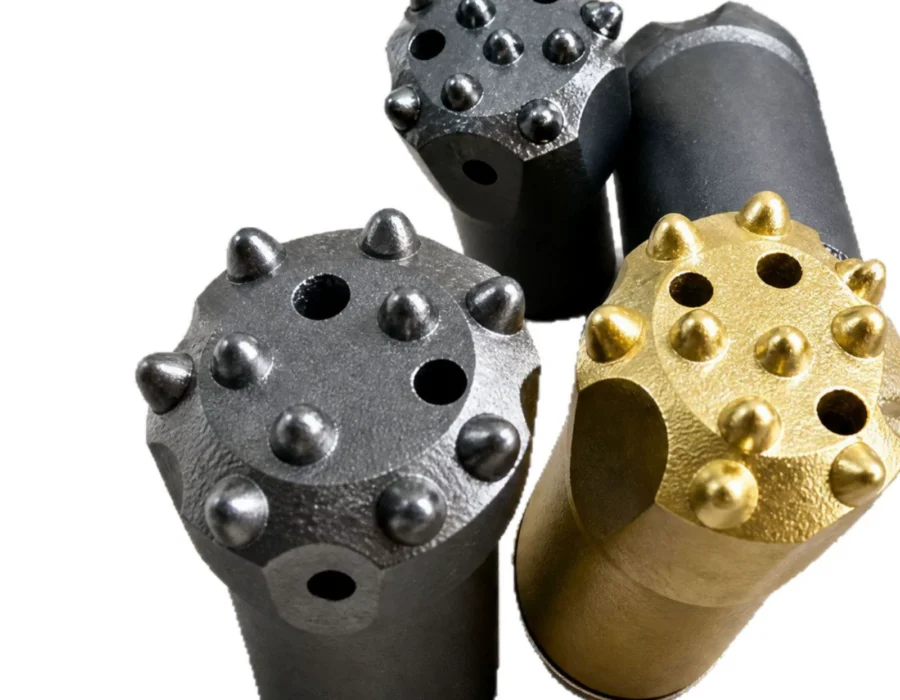
Use a button bit with strong gauge coverage when mining exploration crosses rock containing more than 20% quartz. Keep WOB at 1,000–3,000 lbf/in of diameter and rotation at 25–60 RPM; DTH air pressure stays within 0.7–2.4 MPa. Wear cannot be eliminated, so planned inspections and short performance comparisons are essential.
Abrasive formation is defined here by quartz content above 20%, not by a single UCS band. A medium-strength sandstone can therefore wear a bit faster than a harder but less abrasive rock. Mining exploration compounds the problem because diameter, hole direction, and sample continuity must remain credible over changing intervals. The correct strategy is to manage contact and flushing while measuring loss, rather than assuming a tougher material grade will solve every wear mechanism.
Which parts of the bit need protection first?
The gauge row is the first control point because it defines hole diameter. Outer buttons travel farther per revolution than central inserts and meet wall contact as the assembly moves. In quartz-rich rock, a small reduction at the gauge can lead to tight rods, added reaming, and more wall damage. A design with distributed gauge buttons and clear flushing paths is preferable to one that concentrates all outside contact on a few inserts.
Face buttons also need enough protrusion to create fractures without carrying unsupported bending loads. Inspect for flats, micro-chipping, missing inserts, and steel erosion around the pockets. Body wash can expose an otherwise usable button. The abrasive formation archive frames the quartz threshold, while the mining exploration archive connects wear to the information expected from the hole.
How do parameters change the wear pattern?
Stay within 1,000–3,000 lbf/in of diameter and 25–60 RPM for button drilling. Increasing rotation inside the range creates more contacts per unit time, but it also increases sliding distance. If penetration does not respond, the extra rotation may only polish buttons and gauge steel. WOB must keep impact transfer stable; it should not push a blunt structure through the rock by force.
For DTH work, air pressure remains 0.7–2.4 MPa. Cleaning is important because quartz chips recirculating under the face act as a grinding charge. The data does not supply an airflow-volume range, so the driller should rely on return quality and hammer response rather than publish a new number. Fine, hot-looking dust or a falling return size can indicate recutting, button flats, or both.
| Wear driver | Known threshold or range | Observed consequence | Field response |
|---|---|---|---|
| Abrasive mineral content | Quartz above 20% | Fast gauge and face wear | Shorten inspection interval |
| Button WOB | 1,000–3,000 lbf/in of diameter | Controls face coupling | Avoid forcing blunt inserts |
| Button rotation | 25–60 RPM | Changes contact and sliding distance | Use response, not maximum RPM |
| DTH air pressure | 0.7–2.4 MPa | Supports impact and chip removal | Watch returns for recutting |
What does a useful inspection include?
Clean the recovered bit and measure gauge at consistent points. Count missing or cracked buttons. Mark the location of steel erosion and compare it with flushing ports. Record the interval, rock description, penetration trend, and operating values. A photograph without depth or scale is not enough to explain why the next bit should differ.
Compare wear per drilled interval, not only total life. If one quartz-rich band caused most of the loss, a whole-hole average hides the real mechanism. The ScienceDirect quartz topic offers mineral background. Field selection still depends on the actual chips and the observed bit face.
A consistent inspection method improves the comparison. Use the same gauge points, cleaning method, and photograph orientation for every recovered bit. Note whether a flat is polished or chipped, whether the steel has eroded behind an insert, and whether one side carries more wall contact. These details distinguish mineral abrasion from misalignment or uneven feed.
Do not wait for a complete loss of penetration before inspecting. A gradual change in vibration, smaller return size, or repeated tightness on connections can appear earlier. Pulling at a planned decision point may preserve enough of the wear pattern to identify the cause; running to destruction often removes the evidence needed for the next selection.
Can a harder formation be less abrasive?
Yes. Hardness and abrasivity describe different demands. Granite or quartzite in the 15,000–30,000 psi range can be both hard and abrasive, but the abrasive classification in this task depends specifically on quartz above 20%. A well-cemented limestone may be medium strength with lower quartz wear, while a quartz-rich sandstone may abrade the gauge quickly despite lower UCS.
This distinction affects troubleshooting. Broken inserts can indicate impact overload or poor support. Smooth flats and gauge loss more strongly indicate accumulated sliding and abrasion. Do not answer every wear pattern by increasing WOB. That action can add mechanical damage to an existing mineral-wear problem.
Where is the practical limit?
No button bit is immune to quartz abrasion. A coating, insert shape, or steel grade may change the wear rate, but the brief provides no test data for making a numerical life claim. Avoid promises about hours, meters, or cost. The defensible approach is controlled operation, scheduled inspection, and replacement before gauge loss compromises the exploration hole.
A drag bit is not recommended for this fixed abrasive exploration combination because drag is limited to soft and medium formations and lacks the point-impact structure needed for typical competent mining rock. Button systems remain the primary fit, yet they must be monitored. Accepting that limitation produces a more reliable program than running a worn bit to failure.