
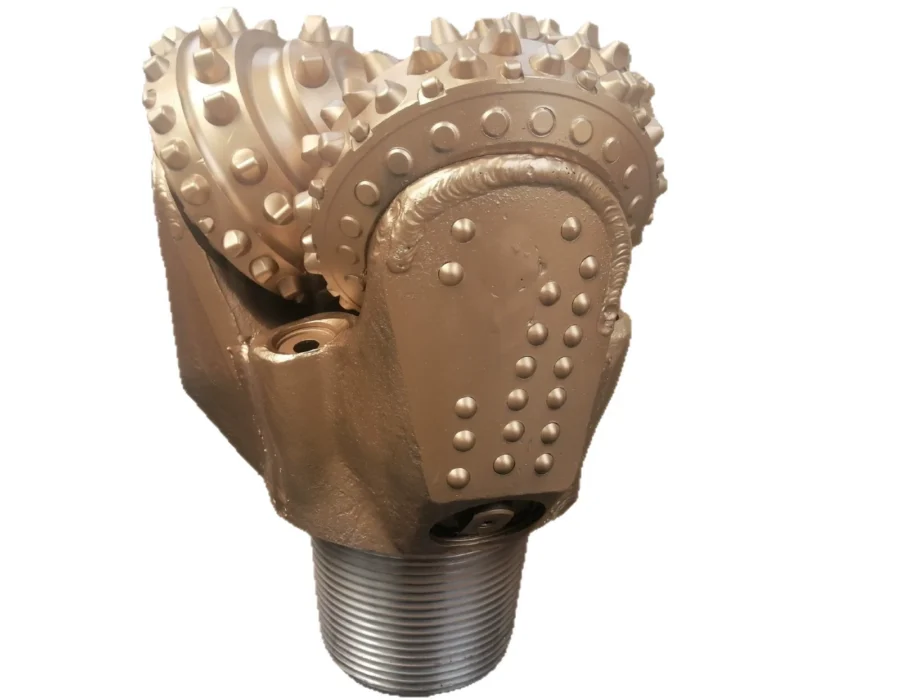
Unconsolidated formation is uncemented alluvium or gravel, where mobile grains and bore stability govern the bit response. Drag tools suit soft loose material at low WOB and 100–250 RPM; tricone selection follows clast hardness. PDC has a gravel restriction, and Button/DTH is not assigned to this formation despite its hard-rock durability.
What does unconsolidated ground do at the bore bottom?
Unconsolidated material lacks cementation between grains. The approved examples are alluvium and gravel. Instead of presenting a continuous rock face, the interval can move, settle, bridge, or slough after the bit passes. Grain size and clast hardness matter together: a soft matrix may contain hard granite or quartzite fragments, and those fragments can control impact and wear even though the formation remains loose.
Bit choice must therefore address removal and stability as well as cutting. Drag bits are compatible with Soft or Unconsolidated ground and can scrape clay, loose sand, or similar material with low WOB. Tricone can cover the full formation range when its teeth or inserts match the clasts. Compare the 75 mm three-wing drag product with the water-well application archive before assuming that loose material requires only one structure.
How should sand and gravel lead to different choices?
Uniform soft alluvium can give a drag face steady contact. The broad scraping structure runs at 100–250 RPM with low WOB, and progress should be judged from torque and returns because no numerical drag loading range is supplied. When the blades become buried or packed, additional load can increase torque without moving clean material to the annulus.
Gravel introduces rolling and impact. A tricone can manage mixed contact more effectively when its structure matches the hardest recurring clasts. Milled-tooth 111, 121, or 131 belongs to Soft material; 437 or 447 fits Medium fragments; 537 or 547 fits Medium-Hard; and 637 fits Hard clasts. The limitation is that the formation’s loose matrix does not erase the strength of individual cobbles.
| Loose-ground condition | Candidate structure | Approved control reference | Critical restriction |
|---|---|---|---|
| Soft alluvium or uncemented sand | Drag | Low WOB; 100–250 RPM | No numerical drag WOB or flow is supplied |
| Gravel with formation-matched clasts | Tricone | 3,000–8,000 lbf/in; 60–120 RPM | IADC code follows clast strength |
| Loose gravel | PDC not preferred | PDC data remains tied to Soft, Medium, or Consolidated compatibility | Gravel interrupts stable shearing |
| Uncemented alluvium | Button/DTH not assigned | DTH values apply to Medium, Hard, or Abrasive rock | Impact does not stabilize mobile ground |
Circulation, packing, and bore stability
Returns are the operating instrument for loose ground. Sand that arrives steadily differs from intermittent slugs, clay balls, or isolated angular cobbles. No numerical liquid-circulation value is assigned to drag or tricone in water-well service, so the hydraulic system must be designed for the actual bore and annulus. A precise borrowed number would be unsupported and could encourage wall erosion or inadequate transport.
Bit selection also cannot prevent collapse. Short exposure, casing strategy, and circulation practice belong to the well or construction program. A tricone may tolerate gravel contact better than a fixed blade, yet it does not hold an uncemented wall open. Button/DTH is not suitable merely because it can break hard cobbles; its compatibility requires Medium, Hard, or Abrasive competent rock rather than mobile alluvium.
Repeated reaming can make the problem worse. In loose sand, extra rotation may enlarge the bore or disturb material that was initially stable. In gravel, a trapped clast can create a torque spike and local body wear. Stop and examine returns after an abrupt event instead of treating every restriction with more RPM. The goal is a passable, clean interval, not the highest short-term penetration value.
Gauge inspection remains relevant even though wall movement can also reduce clearance. A drag edge damaged by a hard cobble can cut an irregular diameter. A tricone may show chipped teeth or uneven cone loading after a stall. Compare recovered tool gauge with bore behavior and clast lithology so cutter loss is not mistaken for collapse, and collapse is not blamed on the cutters without evidence.
How do water-well, construction, and exploration objectives differ?
Water-well drilling must preserve a usable bore for casing or screen installation. Construction drilling through overburden may need a controlled transition into competent rock. Mining exploration can cross loose cover before a hard-rock target, making the bit-change depth part of the geological record. The water-well drilling archive provides the first application context without changing the Unconsolidated definition.
A drag-to-tricone transition may be justified when gravel begins to dominate. A later move to Button/DTH should wait until competent Medium, Hard, or Abrasive rock is confirmed and the rig can supply 0.7–2.4 MPa air pressure. PDC should be reconsidered when gravel is present even if nearby sand is Soft. Each application needs a written trigger based on returns and formation contact.
What should be documented before casing or a bit change?
Record grain type, clast lithology, torque behavior, return pattern, drag or tricone identity, RPM, and the depth of any transition. For tricone, include the verified IADC structure, use 60–120 RPM, and keep WOB in the 3,000–8,000 lbf/in band. For drag, retain low WOB and 100–250 RPM. Note any packing, bridge, stall, or sign of wall movement separately from cutter wear.
Water-well references are available from the National Ground Water Association, while the U.S. Geological Survey offers regional information on alluvium and rock units. The explicit boundary is that a bit removes material; it does not guarantee bore stability. A defensible plan links the structure to the matrix, the clasts, and the verified circulation method.