Use a tricone for consolidated sedimentary rock when lithology and hardness vary, or a DTH button bit when the interval is firmly cemented and hard. A tricone runs at 3,000–8,000 lbf/in and 60–120 RPM; Button/DTH work uses 1,000–3,000 lbf/in of diameter, 25–60 RPM, and 0.7–2.4 MPa air pressure.
A consolidated water-well interval is held together by cementation, so the borehole does not behave like loose alluvium. The drilling challenge moves from grain transport to efficient breakage, gauge control, and removal of competent cuttings. Sandstone, limestone, and dolomite may fall in the 4,000–15,000 psi medium range, while harder cemented sections can demand insert teeth or percussion. A single label on a log is not enough; the bit must match the rock actually seen at the face.
Which bit should enter cemented sedimentary rock?
A tricone is the flexible first choice when the well crosses several consolidated lithologies. Milled teeth suit soft rock, while insert teeth suit medium through hard material. The cones roll across the bottom and distribute contact as hardness changes. Select IADC 437 or 447 for medium formations and 537 or 547 for medium-hard sections. IADC 637 is reserved for hard formations. Those codes describe cutting structure suitability; they do not replace an inspection of the returned chips.
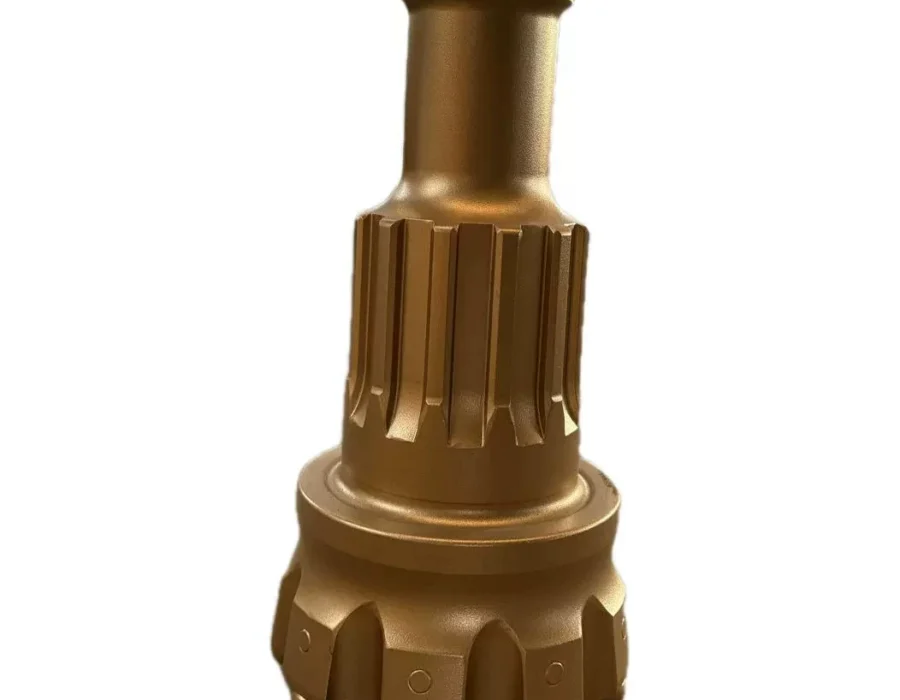
A DTH button bit is appropriate when the hole is in competent hard rock and the rig can provide percussion with 0.7–2.4 MPa air pressure. Carbide buttons concentrate impact on granite, basalt, or quartzite in the 15,000–30,000 psi hard range. The approach can hold gauge well, but it requires a matching hammer and adequate air delivery. The consolidated formation archive describes the bonding condition; the water-well drilling archive keeps completion needs connected to the drilling decision.
How do the operating windows differ?
Run the tricone inside 3,000–8,000 lbf/in of bit diameter and 60–120 RPM. A medium sandstone interval does not automatically justify the high end. Begin with balanced loading, look for distinct chips, and adjust in small steps. High RPM with insufficient bottom cleaning can recut solids and polish the tooth contact. Excess WOB can overload inserts or bearings without creating a proportional gain.
Button/DTH drilling uses 1,000–3,000 lbf/in of diameter and 25–60 RPM because the hammer supplies the primary breakage. Rotation indexes the buttons to fresh rock; it is not intended to turn the assembly into a rotary crushing tool. Air pressure stays within 0.7–2.4 MPa. If penetration falls while air and rotation remain stable, inspect for button wear, poor hammer transfer, or a lithology change before increasing thrust.
| Consolidated interval | Cutting system | Allowed parameters | Selection note |
|---|---|---|---|
| Medium sandstone, limestone, or dolomite | Insert tricone | 3,000–8,000 lbf/in; 60–120 RPM | IADC 437 or 447 |
| Medium-hard cemented rock | Insert tricone | 3,000–8,000 lbf/in; 60–120 RPM | IADC 537 or 547 |
| Hard granite, basalt, or quartzite | Button/DTH | 1,000–3,000 lbf/in; 25–60 RPM; 0.7–2.4 MPa | Percussion provides primary breakage |
Gauge protection and cuttings removal
Gauge loss begins when outer teeth or buttons wear faster than the central structure. Abrasive quartz content above 20% can accelerate that process in any strength class. Watch the diameter of returned pieces and the energy needed to re-enter a connection. A steadily tighter trip can indicate gauge wear, wall irregularity, or settled cuttings. Do not assume every restriction is a collapsing formation.
The fact table provides an air-pressure range for DTH but no numerical water-flow target for tricone water-well drilling. Circulation should clear the bottom and lift competent chips without inventing a published value. When returns become fine despite stable lithology, the bit may be recutting material. A short parameter reduction and cleaning check is more informative than adding both WOB and RPM at once.
For background on groundwater construction practice, consult the National Ground Water Association. Geological descriptions from the U.S. Geological Survey can help frame regional rock units. Neither source substitutes for the cuttings, torque, and penetration observed on the rig.
What failure patterns signal a wrong selection?
A milled-tooth tricone in medium-hard rock may show rapid tooth loss or slow penetration because its structure is too soft for the contact stress. An insert bit selected too aggressively for a softer interval can drill inefficiently and produce unstable tracking. Bearing heat, chipped inserts, and repeated stalls call for inspection rather than continued loading.
Button bits fail through flats, broken buttons, body wash, or reduced gauge. Low rotation can repeatedly strike the same track, while excessive rotation can raise wear without improving impact transfer. A DTH bit is also not suitable where the rig cannot supply the required hammer system and air pressure. That equipment limit is decisive even if the formation itself favors percussion.
How can the next bit run be improved?
Record lithology, penetration trend, WOB, RPM, air pressure where applicable, and the condition of the recovered bit. Separate medium carbonate performance from hard igneous performance rather than averaging the whole interval. Use the record to decide whether the next run needs a different IADC structure, a DTH assembly, or only a parameter correction.
The goal is a gauge hole that accepts the planned casing without unnecessary reaming. A tricone offers broad adaptability across consolidated sedimentary rock. A DTH button bit provides focused hard-rock breakage. Neither is universal: the tricone must match hardness, and the DTH system depends on percussion equipment and adequate air.