
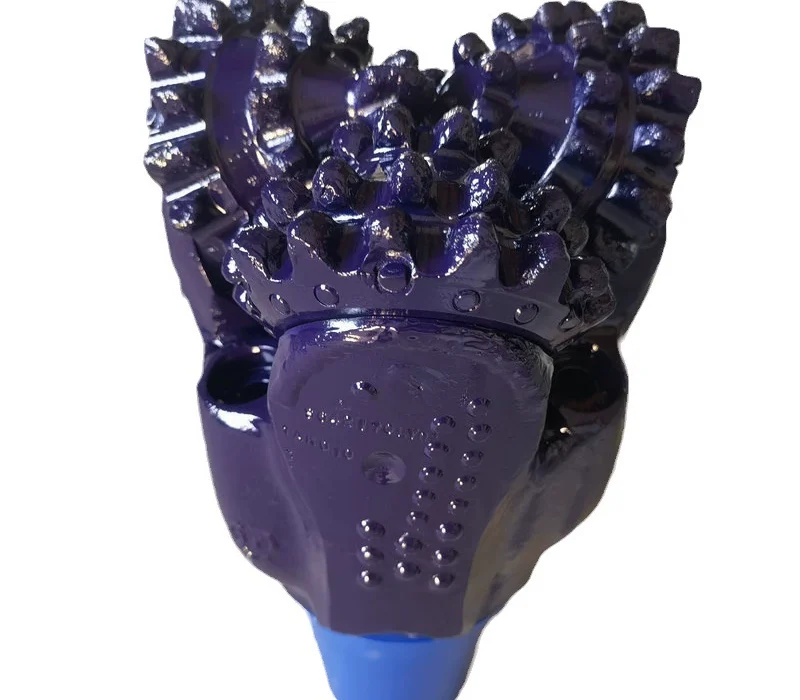
Choose a drag bit for clean, loose sand and a correctly selected tricone when gravel interrupts the interval. Keep the assembly stable, use low WOB with the drag bit, and hold it within 100–250 RPM. Unconsolidated alluvium can collapse or pack around the bit, so hole cleaning and short parameter changes matter more than aggressive loading.
Water-well drilling through uncemented alluvium is a transport problem as much as a cutting problem. The formation has no reliable bond between grains. Sand moves, gravel rolls, and the borehole wall can shed material after the cutters pass. A bit that drills quickly but leaves a packed annulus or an enlarged, unstable hole is not a productive choice. The selection must therefore match both the grain framework and the circulation system available on the rig.
What bit geometry works in loose sand and gravel?
A drag bit is the direct choice for clay, loose sand, and other genuinely soft ground. Its blades scrape a broad face and can advance with low WOB. The design is simple, and there are no cones or bearings to trap coarse particles. In uniform sand, that broad cutting action can produce a steady hole at 100–250 RPM. The driller should avoid forcing the bit when returns begin carrying larger slugs of material. Added load can bury the blades and increase torque without improving penetration.
Gravel changes the decision. Loose cobbles can roll under a fixed blade, chip an exposed edge, or wedge between the body and the borehole wall. A tricone selected for the actual hardness of the clasts gives three rolling contact zones and tolerates mixed particle sizes better. If the matrix is soft but the gravel contains hard quartzite or granite, treat the clasts as the limiting material. The unconsolidated formation archive provides the broader ground definition, while the water-well drilling archive keeps the application constraints in view.
How should WOB and RPM be adjusted?
Start the drag bit at low WOB and use RPM inside the approved 100–250 range. A clean torque response is more useful than a single target number because the data table does not assign a numerical drag-bit WOB. When torque rises while penetration falls, reduce loading and restore circulation before adding rotation. That response usually indicates packed cuttings, a buried blade, or material sloughing onto the bit.
For a tricone, use 3,000–8,000 lbf/in of diameter and 60–120 RPM. The lower part of each range is the safer starting point in unstable gravel. Increase one control at a time, then watch torque, return character, and penetration. A sudden torque pulse can be a cobble moving under a cone rather than a demand for more WOB. Milled teeth fit soft material; insert teeth are the better match when the gravel contains medium or hard rock fragments.
| Ground condition | Preferred starting bit | Permitted operating reference | Main limitation |
|---|---|---|---|
| Clay or uncemented sand | Drag bit | Low WOB; 100–250 RPM | Blades can pack when cleaning falls behind |
| Loose gravel with mixed clasts | Tricone matched to clast hardness | 3,000–8,000 lbf/in; 60–120 RPM | Rolling cobbles can create impact torque |
| Soft matrix with hard fragments | Insert tricone | Use the tricone range above | The hardest clasts govern tooth choice |
Hole cleaning and wall stability
Circulation must remove grains before they settle behind the bit. The task brief does not provide a water-flow range for drag or tricone water-well work, so a numerical flow target would be unsupported. Set the available system to maintain returns without eroding the borehole wall. If the annulus carries clean fluid but the bit torque climbs, stop treating more pump output as the only answer. The problem may be a local bridge, a ball of clay around the blades, or a cobble trapped beside the body.
Short connections and controlled trips reduce the time an unsupported interval remains open. Do not repeatedly ream a loose zone at high rotation. That practice can enlarge the hole and make later casing or screen placement harder. Track the cuttings at the surface. A change from sand to angular rock fragments is evidence that the bit has entered a different material, not merely that the rig needs more weight.
The National Ground Water Association is an appropriate external reference for water-well practice. Its material can support planning, but site observations still control the bit response. No online reference can identify a buried gravel lens from torque alone.
Where do these bits usually fail?
Drag bits commonly fail through edge wear, blade packing, and impact damage from material they were not intended to crush. A drag profile is a poor fit for a gravel bed dominated by hard cobbles. Continuing after repeated torque spikes can deform the cutting edge and leave the hole under-gauge or irregular. The correct response is often a bit change, not a larger control input.
Tricone problems include chipped teeth, cone tracking, and bearing exposure to abrasive solids. Quartz-rich clasts raise wear even though the surrounding formation is unconsolidated. Use an insert structure when the clast hardness requires it, and inspect the bit after any severe stall. A tooth pattern intended for soft ground cannot be expected to survive repeated hard-rock impacts simply because the matrix is sand.
What should the driller verify before casing?
Confirm that the interval was drilled with stable torque, recognizable returns, and no repeated packing event near final depth. Work the assembly only enough to verify passage. Excessive conditioning can disturb ground that was initially serviceable. Record which bit crossed each change in returns because that history helps explain later tight spots.
Before the casing or screen is run, review the honest limitation of the selected bit. The drag bit is efficient in soft, uncemented material but is not suitable for gravel dominated by hard clasts. The tricone can handle the mixed contact better, yet it does not prevent wall collapse. Bit choice, circulation, and exposure time must operate as one plan.