
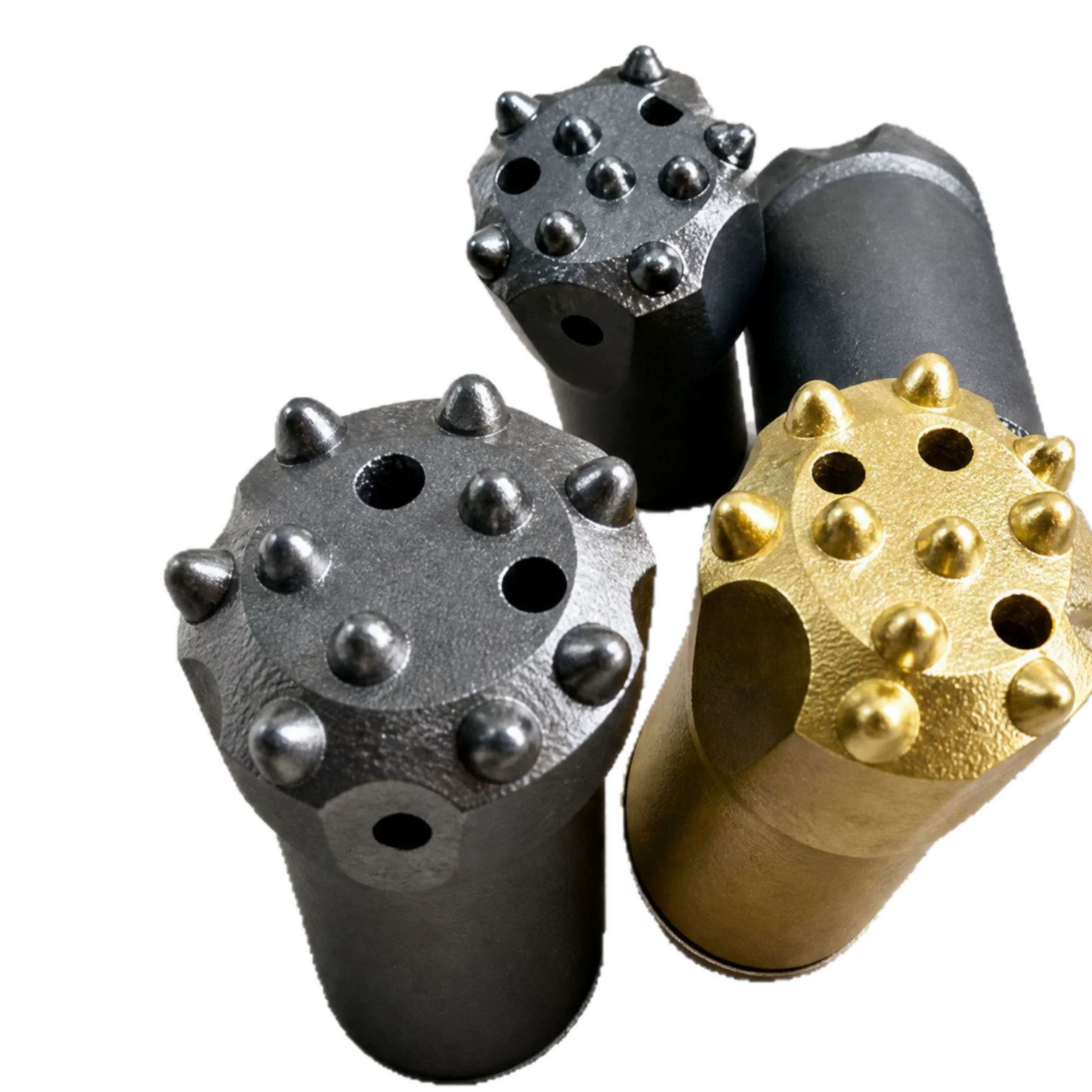
T38/R38 Multi-Tooth Button Bit for Rock Mining

T38/R38 Multi-Tooth Button Bit for Rock Mining

T38/R38 Multi-Tooth Button Bit for Rock Mining

A multi-tooth carbide button family for separate T38 or R38 mining systems, requiring verified hole gauge and face data.

Request Pricing

Technical Specifications

Model / SeriesT38/R38 Multi-Tooth Series
Size Range (in / mm)T38 or R38 nominal 38 mm class (about 1.50 in); hole gauge not stated
Body Material (matrix / steel)Threaded alloy steel body
Cutter / Insert / Tooth ConfigurationMultiple carbide buttons; exact count not stated
Blades / ConesMulti-tooth face; profile not stated
API ConnectionSeparate T38 or R38 models
Circulation / Nozzle PortsModel-specific flushing arrangement not stated
Bearing / Seal TypeNot applicable — fixed button structure
Recommended WOB1,000–3,000 lbf/in of dia
Recommended RPM25–60
Condition (new / rebuilt / rerun)New
Availability / Lead TimeMade to order
SKU / Part NumberRDB-BTN-024

Product Description

This multi-tooth carbide button family is described for separate T38 and R38 threaded mining systems in rock drilling and excavation. Both names occupy a nominal 38 mm, or roughly 1.50-inch, thread class, but they use different profiles and require distinct rods. Define the use through the mining and exploration application archive and assess the material through the medium formation archive. The product name does not supply the hole diameter and should not be used as a gauge specification.

The source states impact and wear resistance, a multi-tooth carbide face, and T38-R38 threaded construction. An alloy-steel threaded body with fixed carbide contacts is documented conservatively, without turning performance adjectives into guaranteed life. The exact number and shape of buttons, face recess, skirt, hole gauge, and flushing layout are not identified. A selected model must be verified as either T38 or R38, never both, and its thread shoulder and gauge must be checked against the active drill string.

Use 1,000–3,000 lbf/in of actual diameter and 25–60 RPM after a model drawing provides the missing hole gauge. Medium, hard, and abrasive rock can suit the button mechanism, but quartz-rich or fractured intervals need closer inspection of gauge and thread condition. Document both the selected thread and measured gauge on every run sheet before comparing performance between bits. Flow is blank because thread naming does not establish rod bore or port area. The stated limitation is absent gauge and face data. Rock-property terminology can be reviewed through the ScienceDirect rock-mechanics reference.

Frequently Asked Questions

Why is the hole diameter not listed as 38 mm?

T38 and R38 are thread-series designations, not confirmed bit gauges. The nominal number describes the connection class, while the finished hole diameter depends on the selected model. Obtain a product drawing before calculating load or confirming the drilling pattern safely.

Does multi-tooth identify an exact button count?

No. It indicates more than a minimal tooth layout but supplies no verified quantity or distribution. Face, gauge, and flushing positions must come from a drawing. Avoid assigning a button count from the image unless it can be inspected clearly and documented.

Request a Quote

Send your bit type, diameter, formation, connection and quantity to receive pricing and availability.

Request a Quote