
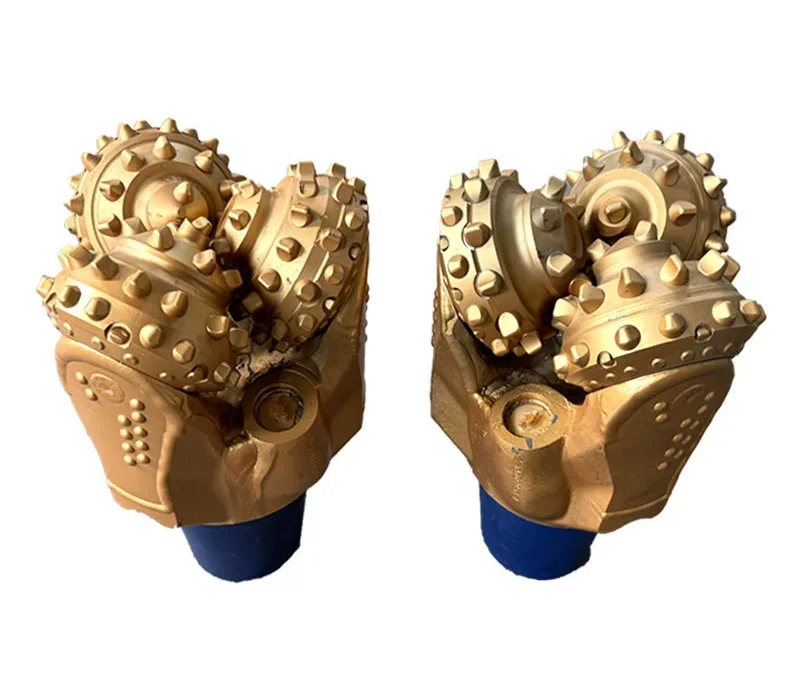
The Medium class covers UCS from 4,000 to 15,000 psi; its examples are sandstone, limestone, and dolomite. PDC, insert tricone, Button/DTH, and selected drag structures occupy different parts of this range. Separate strength from quartz abrasion, match the cutting mechanism to the application, and change parameters only inside the approved family envelope.
Where does Medium formation begin and end?
The authorized Medium band starts at 4,000 psi and ends at 15,000 psi UCS. Sandstone, limestone, and dolomite are its representative lithologies. That range is broad enough to contain different grain fabrics and cementation states, so the classification is a first screen rather than a complete design. Carbonate rock may break differently from sandstone at a similar UCS, and a sandstone can introduce an additional abrasive condition when quartz exceeds 20%.
Four bit families can enter the discussion. PDC is compatible with Medium formation. Tricone insert structures 437 and 447 are assigned to Medium rock. Button and DTH tools also fit Medium ground when an impact system is appropriate. Drag bits extend through Soft–Medium service, but their low-WOB scraping action is not a universal answer for every cemented interval. Review the 90 mm DTH button product beside the 75 mm concave PDC product before reducing the choice to diameter alone.
Which mechanism fits sandstone, limestone, or dolomite?
PDC shearing can suit an oilfield, offshore, or directional interval where the rock presents a stable face and the hydraulic system can keep cutters exposed. Insert tricone 437 or 447 provides rolling contact for Medium rock and can be selected where formation variability or impact tolerance favors cones. Button/DTH introduces percussion for construction, mining, water-well, or geothermal work with competent contact. The mechanism must agree with both the rock and the rig.
Drag action remains limited. Although the approved range reaches Medium, the fact set characterizes drag as most compatible with Soft or Unconsolidated ground. A lightly cemented section may respond to scraping, while stronger limestone or dolomite can make that route inefficient. The selection note should state this restriction explicitly instead of presenting every 4,000–15,000 psi interval as equally suitable for a drag profile.
| Medium-rock mechanism | Formation assignment | Load and rotary window | Additional approved reference |
|---|---|---|---|
| PDC shearing | Medium | 2,000–10,000 lbf/in; 60–300 RPM | 8.5-inch class: 250–650 gpm |
| Insert tricone | Medium; IADC 437 or 447 | 3,000–8,000 lbf/in; 60–120 RPM | Flow established by the drilling program |
| Button/DTH impact | Medium | 1,000–3,000 lbf/in of dia; 25–60 RPM | 0.7–2.4 MPa air pressure |
| Drag scraping | Soft–Medium | Low WOB; 100–250 RPM | Best aligned with softer or loose ground |
How should UCS and abrasiveness be separated?
UCS describes resistance to compressive loading. The abrasive definition uses a different measurement: more than 20% quartz. A Medium sandstone can therefore carry both Medium and Abrasive descriptions. That combination does not change its UCS band, but it raises the expected wear burden at the face and gauge. Limestone or dolomite within the same strength range may not cross the quartz threshold, so equal strength does not imply equal wear.
Track the two properties in separate fields. The interval log should name lithology, UCS class, and quartz status before choosing the bit. Rapid peripheral wear with acceptable penetration can point toward abrasion, while low advance without severe wear can point toward cleaning, energy transfer, or an unsuitable mechanism. Do not assign a Hard code merely because a Medium sandstone is abrasive; the tricone code still follows strength, with 437 or 447 reserved for Medium.
Gauge design and cutter exposure should be reviewed with the same separation. A carbonate interval that produces blocky chips may challenge removal without being quartz-abrasive. A quartz-rich sandstone may maintain penetration while steadily wearing the outside row. In both cases, record where material is lost from the bit and whether the hole becomes tighter on re-entry. That evidence is more specific than a single dull grade and helps distinguish a hydraulic correction from a new cutting structure.
Application-specific operating choices
An oil and gas section may compare PDC against a 437 or 447 tricone. Construction work can instead favor Button/DTH because the available rig delivers impact and the hole objective accepts that method. Geothermal drilling may use insert tricone in cemented sedimentary rock, then prepare for a different structure if the bore reaches Hard basement. The construction drilling archive frames one of these routes, but it does not alter the numerical formation limits.
Each family keeps its own controls. PDC carries 2,000–10,000 lbf/in and 60–300 RPM, with 250–650 gpm restricted to the 8.5-inch-class case. Tricone uses 3,000–8,000 lbf/in; its speed band is 60–120 RPM. For Button/DTH, rotary speed is 25–60 RPM, pressure is 0.7–2.4 MPa, and WOB is 1,000–3,000 lbf/in of diameter. Borrowing one family’s flow, air, or speed figure for another family is not suitable.
Connection review also stays independent from formation suitability. A mechanically fitting assembly can still carry the wrong cutters for sandstone or carbonate. Confirm the actual interface, but use lithology, UCS, quartz content, and rig mechanism to approve the bit. This prevents a convenient shop fit from becoming the only reason for a field recommendation.
What should be checked after the first stand or hole?
Review returned fragments, torque stability, advance, gauge condition, and the location of face wear. Distinct sandstone or carbonate chips support a different interpretation from recut fines. A 437 or 447 tricone that wears unevenly may be loaded poorly or may have crossed into a stronger band. A button face with peripheral loss in quartz-rich sandstone may be showing the separate abrasive risk.
Document the evidence before changing structure. Science and engineering background for rock behavior can be reviewed through ScienceDirect rock-mechanics topics, and bit-classification material is available from IADC. Neither reference supplies the missing project details. The practical record must connect the selected mechanism, the Medium lithology, its quartz status, and the observed response.